The Eddy Roundtable: Pouring it Forward
How The Eddy helped shape Providence’s future craft cocktail scene.

From Left: Brittany Simons, Leishla Maldonado, Jesse Hedberg, Parker Luthman, Trinity Auriemma, Catherine Hood, Jen Davis and Horus Alvarez sharing a toast at The Eddy. Photo by Wolf Matthewson.
The April issue of Rhode Island Monthly features “Cocktail Culture.” Below is an extended interview from a roundtable that took place this winter as part of the guide. More coming soon! Find out where to raise a glass in Rhode Island and meet the bartenders who’ve perfected their craft. The April issue is currently being delivered to subscribers and will be on the newsstand starting March 30. Find the issue here or subscribe.
I’m standing in the middle of the horseshoe-shaped bar at The Eddy, right in the drink well where bartenders measure spirits, rattle shakers, and stir and pour cocktails. I’ve always wanted to bartend, but right now my tools are a notebook and pen and my phone doubles as a recording device. I am surrounded by eight acclaimed bartenders in Providence’s craft cocktail scene, and many of them got their start here at The Eddy, a renowned Providence craft cocktail bar celebrating more than thirteen years in business. While there were other restaurants that served craft cocktails before it — including the beloved Dorrance and Cook & Brown in Providence, and Fluke Wine Bar and Kitchen in Newport, all closed [pour one out for ’em] — The Eddy is one of the originals that still exists and has inspired so many former staffers to open cocktail bars of their own. With that thought in mind, I gathered this legendary group together to find out what exactly The Eddy means to them.
Jen Davis: Former bar manager at The Eddy, current bar manager at Gift Horse
Jesse Hedberg: Former bartender at The Eddy and current co-owner of Pizza Marvin and Club Frills
Horus Alvarez: Former bartender at The Eddy and bartender at Dolores and Club Frills
Catherine Hood: Former bartender at The Eddy and current bar manager at Machines with Magnets
Leishla Maldonado: Former bartender at The Eddy and current co-owner and beverage director at Loma
Parker Luthman: Former bartender at The Eddy and current bar manager and beverage director at Murmur HiFi Lounge
Brittany Simons: Current manager at The Eddy and co-owner of Kingfish
Trinity Auriemma: Current bar manager at The Eddy
Michael Silva [not pictured in group photo]: Former beverage director at the Dean Bar, owner of BĀS, and current bartender at The Eddy
_______________________________________________________
I’ve got an all star group here, so collectively, where do you think the craft cocktail scene started in Rhode Island?
JESSE: I’ll start that off because I think I’m the oldest and go back to farthest. Personally, I started at Fluke in my late twenties, or maybe I was thirty. The woman who ran the beverage program there was Jerri Banks, and she worked for Dale DeGroff back in the day, who is literally the person accredited worldwide with starting the renaissance of cocktails. When I started bartending in my early twenties, drink lists didn’t exist. There was no such thing as a cocktail menu. You ordered martinis or gin and tonics. So at Fluke, Jerri was squeezing fresh juices and making syrups. As a creative person, I caught the itch. I got some of Dale’s books, which really piqued my interest to the point where I started making every drink in the book.
How many people here have read Dale DeGroff’s books? [Everyone raises a hand and says yes].
And that’s so ironic that he has now settled in Westerly.
LEISHLA: A lot of us know him personally too.
JESSE: And then from Fluke, I caught wind that Cook & Brown was opening and it was the first place in Providence to start to have more of an emphasis on classic cocktails.
JEN: Jesse and I met at Cook & Brown.
JESSE: Basically, Jen, Jay Carr and Jon Dille, who both were at the Garden Grille at the time, became regulars at Cook & Brown, and we all just started going through learning how to make classic cocktails. I was an opening bartender there, and we would go online and discover old classic cocktail recipes we had never heard of before. And then Mike Lester was opening The Dorrance, and he said I really want you to consider working for me.
Oh so he poached you, did he?
JESSE: Yea, he poached me.
JEN: But you were working at Cook & Brown and Fluke at the same time, and this was the first time you could start your own thing.
JESSE: So it was Jen, Jon Dille, Jay Carr, myself – a lot of J’s – and then Vito Lantz. So that was the opening crew, and The Dorrance took off.
I remember all those incredible marketing and comedy videos they used to do.
JEN: That was all Vito. So at The Dorrance, Jay managed the bar after Jesse left, but then he got the opportunity to open The Eddy.
JESSE: And then Jon Dille had the Grange. Around the same time that The Eddy opened, The Grange opened and Justine’s opened, and I was helping Mike [Sears] with Justine’s. We all had, at that point, moved on from The Dorrance, and that was the first branch off. Vito was running The Dorrance and had a sick crew of young guns.
JEN: He had a huge impact on so many young bartenders. One now works at Overstory [in New York City], then there’s Tyler Schweppe who works in Portland, Maine.
It’s an epicenter that spread out to so many people.
JEN: And I think that it’s very important to talk about The Dorrance, like you can’t have The Eddy without those places.
So the Eddy is over thirteen years old, right? I remember, because the first time I came in, I was expecting my son, who’s now twelve and a half. And I had to secretly go up to the bartender, like, can you make me a mocktail? And they didn’t hesitate, before that was a cool thing to do. So let’s talk about The Eddy and how it brought you all together. I know so many people started here, and some of you work here now. So who wants to start on what The Eddy has meant to you all these years?
JEN: I guess I can start. I started working here because Jay (Carr) got the opportunity to open up The Eddy, and he was building his team. And I was like, hey, I want to be in on this. I got to be part of the opening team. Jay wanted it to be like the cool cocktail bar. Jesse, Jon, Jay and I would all go up to New York a lot together as a crew to see what was going on. Because there was nothing like this place. As much as The Dorrance was a huge part of it, it was still a restaurant with a really amazing bar program, whereas this was the first true cocktail bar. He had a very clear vision of I’m gonna make the bar that we’re going to in New York and Boston, and just have it focus on cocktails. It really took off. Jay put a Sazerac and a “Bartender’s Choice” on the menu.
And now Jay is at Track 15. That’s a pretty big gig there.
JEN: There were a lot of ups and downs, because it was really busy, and we all of a sudden had to get these systems in place. And that’s where I started to come in. I knew how to operate things, and I had done the cocktail apprentice program. Three years in, I started being the manager here, and then they were getting ready to open Durk’s. So Jay went over to run Durk’s, and I stayed here to run the bar program. One thing I wanted to do was make it a place where people could come and learn and grow, then go on. That was always my goal. That was something Jesse did for me.
So what does this place mean to you to pass the torch to so many, and look around this room and see how many people have done their own thing?
JESSE: I came into the mix way after things had been established. And as a bartender who has had success in my career at that point, I was thrilled to work here. The Eddy to me, since it opened, has always been the epicenter. Not to take anything away from Vito running The Dorrance at that point, but it shifted when The Eddy opened. Jen can say that she came up under my wing, but Jen took mentorship beyond anything I ever did. I credit Jen for being the real OG mentor of the cocktail scene, because she has had incredible influence on a lot of people.
JEN: When I think about the Eddy, I think about how we were able to build this cool clubhouse for us. This was everyone’s safe space. It’s always been like throwing a big party every night, and you get to give [guests] a great experience. It always felt like this was our house.
I know I saw a big bash here. Was it for the ten year, or what? What was that like to celebrate ten years? I remember people dancing on bars [laughs].
JEN: Messy.
BRITTANY: The last time all of these people have been in the same room together, was probably then. But even that is a little bit blurry.
JEN: There was crazy stuff, but the core of it was building this team. Getting back to when I did take over, the first person I hired was Horus, and the reason why it was such a big deal for me was because Horus is the most humble person, but so talented, and also such an incredible mentor for everyone who worked here. So if it wasn’t for him being here, I wouldn’t have had such a solid team.
HORUS: When I moved here, finding this place was like finding a gold mine. My first time here, I googled “cocktail bars,” and I remember sitting in one of the corners by the window, and I was like, this is such a beautiful spot.
What year was that?
HORUS: 2012. I remember just feeling the energy. Everyone was very enthusiastic. Everyone wanted to provide a good cocktail. The list was solid. It was like this place belonged in New York or. L.A. When I moved out of Washington, D.C., I was supposed to move to Boston, but my friend Joaquin Meza [co-owner of Dolores] said move to Providence. It was because of him I got my first job working at Cook & Brown. My main goal was to work at The Eddy at some point. I applied and sent my resume to Jay Carr, then I got a job in Boston and months went by, and one day, I showed up at The Eddy. Jay was like, ‘Hey thanks for replying to my email.’ He said, ‘We offered you a job.’
JEN: We offered him a job in November and this was March [laughs].
HORUS: I had deactivated emails from when I was in D.C. But I went back to my email and found the receipts. I was so embarrassed, but I asked again if they were hiring, and Jen said to come in on Sunday.
JEN: We interviewed you in the alley.
HORUS: We chatted for ten-fifteen minutes. And she was like yea, just come back and work. And that was it. I was nervous but excited. I was like this could have been three months ago. The bar has always been run as a very clear example of organization and team leadership. And it was clear that we wanted to create a culture, not just great cocktails. I was lucky enough to work in a couple places that were fine dining, but I always wanted to focus on craft cocktails, because it’s a movement. There was romance, there were stories, it was fun. It was connected to hospitality. One of the things that was so attractive about this place, was that Jen wanted to focus not just on the quality of the ingredients, but also the experience. No matter how talented anyone can be, some of that knowledge can be passed along to the next generation.
JEN: We’d change our menu every four months, so quarterly with the seasons. We’d have a menu meeting and we’d each bring a cocktail to the table and we’d all taste it, and work on it together as a team. That was an essential part of building the team. I also got the chance to bring Catherine [Hood] on, which was cool because she comes from a very different background in terms of creativity, and has a true artist mindset.
JESSE: I just remember Catherine’s shake. Like who is this woman? She had an elegance behind the bar. Jen was really good at letting people shine in their own way behind this bar, while still being true to The Eddy.
CATHERINE: I remember staging in December of 2016 before I started here in January of 2017. That past December I had also staged at The Hawthorne and Eastern Standard [in Boston]. I really wanted to work at both of those places and I tried to get a job here before that, but it just didn’t work out for whatever reason. And Jared and Jackson [Cannon, co-owner of Eastern Standard] were both like, you should just work at The Eddy. Why do you want to work in Boston? And then, luckily, a month later, it worked out.
What did it mean to you, coming in here and working with this incredible team?
CATHERINE: It’s like being back with a family of sorts again, but getting the chance to develop a deeper knowledge and appreciation for spirits.
And now you’re at Machines with Magnets, and I know that you give a lot of bartenders a chance to test out their own concepts through popup bar nights there. So tell us a little bit about that.
CATHERINE: It’s just having the flexibility with the event space, not like a traditional bar or restaurant setup. We don’t have daily operations that we have to consider as much so we have a lot more room to allow different folks to come and use the space through sponsorships.
I know Parker [Luthman] did a popup with Play it Cool and Michael [Silva] with BAS, and even Dolores had one, too.
JESSE: Machines with Magnets is the most under the radar bar in the greater Providence area, because it’s not open day to day. Catherine just has such a great sensibility of flavor and interesting combos.
The common theme here is also education. It feels like every one of you has worked really hard to educate the next generation, and I know that came into play with your relationship [gestures to Jen and Leishla] in the beginning. So, Leishla, do you want to speak a little bit about that?
LEISHLA: Yeah, I will cry, so just like, look away. I wasn’t here in Providence yet when it was already established. And what I think is beautiful about Jen is that she is this historian. She’s told us so many stories about Jesse, and what his mentorship meant to her, and what he did for this industry. And she talked so much about Vito. So even to this day, working behind my bar, people ask, how long have I been doing this? And then I get to give credit, which I do in full detail, because it’s ingrained in my mind from hearing the stories and understanding where this industry started. I get to talk about the people that founded it, right? I remember when I first walked in here, I was coming home from my job in Boston. I had just moved here in 2016 and I was still bartending in Boston, and I didn’t even know what this place was. It is really close to the train station and I had my backpack on. I’m meeting Osman, my partner, for a drink, and we sat in the same window, the same seat that Horus sat in when he first came here. I came in four or five times, and I would always order one drink, the Naked and Famous.
JEN: That was how I knew that she knows something about cocktails. Parker and Leishla both got hired as guests, basically, and it’s because they were being nerds.
LEISHLA: First off, I gravitate towards spaces that have women leadership, and I think that’s super important. I only really like to work in spaces that have that. I was so intimidated talking to her, so I would just sit in that corner, like, I can’t talk to this lady. She’s untouchable. And I came up to pay, and she’s like, you work in the industry, right? And I said, “Yeah,” and she said you should come interview with me. I stayed up late the night before, and I was like, I have to make them something for interviewing me. This is such an opportunity. When I started to hear the impact of The Eddy and how important it was to cocktail culture here, I couldn’t go empty handed. I made a syrup with toasted oak and lime zest. And they interviewed me for Durk’s, and at the end, I was like, I have a syrup for you guys. It’s corny, I know, but here’s a gift. And Jen automatically opens it up. I’m terrified, and she tastes it. She’s like, “This is pretty good.” She takes it over to Jay, and he’s like, “Yeah, it’s pretty great.” Then she said, “Do you want to work here too? Do you think you’ll have the time?” And I was like, “This is where I actually want to work. So this is cool.”
JEN: What we do is still a weird niche thing. There are a lot of bartenders and there’s a lot of great bartenders, but then there’s not a lot of cocktail bartenders, so when you see someone who might have the interest to do this crazy thing, because it’s so much extra work. You’re tasting all the shit, you’re reading all these books, you’re going to all these events, like you really have to care about it. So anytime you can smell it on someone, you want them to come work here, because it’s hard. You can’t just put up a Craigslist ad and hire someone with bartending experience. They have to have the drive to do this, especially because working at this bar, you get in at 3 p.m. and you’re going through like, four or five turns, which is crazy. You get the after work crowd, and then you get the before dinner crowd, and then you get the after dinner crowd, and then you get the people who get out of work and then come here. So it’s just such a long shift.
So Parker, can you tell us about your origins here?
PARKER: I remember being exposed to The Eddy, because I used to walk this street as a student going to my tech classes studying Business and Entrepreneurship at Johnson and Wales. I was twenty, and I was like, when I turn twenty-one, I’m going to this bar. I randomly had a free elective in my last year at JWU, and I took a spirits and cocktail education course as a free elective. That’s kind of what led into my deep dive into front of house operations and beverage specifically. And so I came in on my twenty-first birthday. They had a drink on the menu called the Grow a Pear. It was a mule with Bols Genever and pears, and it was the most delicious thing I had ever drank as a freshly twenty-one-year-old, not making jungle juice in my dorm. And I was like, this is really cool. This feels like cooking. And so that’s kind of when I got into it. I was finishing up school, and I knew I had to have an internship and direct work experience through Johnson and Wales. But I was interested in cocktails and spirits. Jen was bartending behind the bar. We were drinking. And then I just kind of asked her what books she read, because I was a huge nerd.
Do you remember what she said?
PARKER: She gave me a list of ten books, and I wrote them all down haphazardly on a piece of paper. Then when I went to pay, she was like, “Do you want my email to set up an internship?” And I think my soul left my body, because I just never thought that that was ever going to be an option. That’s kind of how I started here. I started making syrups, cleaning the floors, and working with Jen on inventory.
I started my internship around the time when Horus came on and Jesse was here, so those two were bartending together and managing the floor together. And R and D-ing a lot of drinks all the time. There was one time when I worked with Jesse and he was R and D-ing this tropical drink with banana and lavender, and I’ll never forget getting exposed to Jesse’s thoughts around flavor mapping and the manipulation of ingredients, because back then, it was beyond anything that I could comprehend. To this day, I’ve had the opportunity to work with everyone. They continue to embrace me and also push me to continue to go after things that I wanted, and also allow space for me to fall flat on my face and get up and learn again. And so, I speak so fondly about this space because everyone here allowed me to grow up in this space. I started so young and I didn’t really have a personality. I didn’t really have a drive. I found who I wanted to be and how I wanted to represent myself behind this bar with these people. I have a lot of social anxiety, but I had to get past that to do well in this space. And everyone here kind of pushed me continuously to just do it.
Murmur is in the works, and it’s going to be a lot of the things that I want to carry from this space, and rooted in education and resources. And just allowing space to make mistakes, to have crazy moments of development and personal growth, because that’s what I experienced when I was a young bartender here.
LEISHLA: When we talk about mentorship, Jen has mentored everyone. On my first day interviewing, she let me know that you work set days, and she said that’s the guy you’re going to be working with [points to Parker]. She has a unique ability to pair people with the people that they think that they need to be with. We were able to work on Mondays by ourselves, but then on Saturdays, we all worked together, and she knew we were newer to this side of service, inside of cocktail bartending. Saturdays were a unique opportunity for us to be truly working with our mentor. I remember me and Parker were talking, and I talk a lot, which is a good thing and a bad thing. It’s good when you’re trying to make money. It’s bad when you have to work fast. So Parker and I were standing there, and he’s like you need to stop talking to people and start bartending. That was a good thing, because we had to be very honest with each other, because we worked together for like twelve hours a day.
JEN: The unique thing about The Eddy is there’s only two people working at a time, or three, if it’s Friday and Saturday. So that’s it, there’s no mid-shifts, there’s no split shifts. And there’s also only six to seven employees that work here at a time. You have to be able to be honest with your teammate because it’s messing with your money at a certain point.
BRITTANY: There’s a level of intimacy that comes with working here that does resemble almost a relationship, and that type of honesty with a partner.
LEISHLA: So we sat there, and at the end of the shift, and you were like, I wish that I had the ability to be like that. Hospitality is in my culture. It’s how I grew up. I know how to talk to people because I want to listen, because I love hearing a story. And he’s like, I wish that I understood how you do that. And I was like, well, I wish I understood how you work technically, like you’re fast as hell, and you’re precise and you make really great drinks. That was the turning point where we realized we could learn from each other. And it just changed. Every single shift was completely new for me. I thought Parker’s gonna show me. I was just watching and learning to see how I could do things differently or better. And I’m sure he was collecting, too, like Leishla opens herself up when she talks to someone.
So you took on things he was good at, and he took on things you were good at.
LEISHLA: Then I would come up to Jen, and I asked you the differences between dry Curacao and an orange liqueur. And you are a wealth of knowledge, and you broke it down entirely, and I was like why didn’t I know these differences? It sparked this renewed interest in understanding where spirits come from, how they’re made, understanding the producers, and being able to showcase and highlight a story. I learned from everybody in this room, and Providence is nothing without The Eddy. The Eddy is so instrumental to the success of this cocktail industry. Every single person is doing something really cool and beautiful, and Jen has mentored everyone. I don’t think she’s too humble to take the credit. But I’m like, girl, talk yourself up a little.
So Britt, what has it been like for you to take the reins from Jen?
BRITTANY: I came on in June of 2021, three weeks after Trinity. I actually had the opportunity to stage at The Eddy. I moved to Chicago in 2018, just wanting more. I felt like The Eddy wasn’t hiring at the time, so I felt like there was nowhere else for me to go in order to learn. Before even going to Chicago, I had learned that Jen had a connection to a woman that I wanted to work for out there. I felt weird asking for a recommendation, having never worked for Jen. So I was like, can I just do a stage with you?
JEN: And I was pissed that you were moving to Chicago, because I wanted you to work here. Then when I found out you were moving back, I was immediately like, you’re gonna work here.
BRITTANY: I will say the cocktail apprentice program did a lot for this bar, too, and vice versa. Jen and Parker had reached out to me. I had grown so far away from the industry while being unemployed during COVID, and they strong-armed me back into it. I’m so grateful because it’s led to so many other opportunities. I’m so grateful for this bar and how much it’s brought to my life. And I’m glad, down the line, to be passing the torch to Trinity.
This bar means everything to me. And as I’ve taken the reins, it’s a special place that encouraged me to reemerge as a hospitality professional, but also a as community member in Providence.
Yes, and both of you had your first babies in the industry here.
BRITTANY: That’s a really special thing. Jen is such a titan of the industry. When I got pregnant, it’s such a scary and daunting thing to be working at a bar, because it’s such hard labor. And she was like this was hard for me when I was going through it, so don’t do this or do this, and she helped me get through it. And she has been just a mentor, not only in working, but as a mother, and has helped me so much with this phase of my life.
So you can still have that life and do what you love, right? Even though it’s a nightlife-type gig. You make it happen.
JEN: And Leishla did that for me.
LEISHLA: It was so special being able to be a part of this when Jen was pregnant. I got to watch her grow a baby. And then she would ask me questions about being a mother and working.
JEN: Cela [Leishla’s daughter] was six when you started working here.
LEISHLA: And now she’s fifteen. A full teenager.
And also a future Harvard star.
LEISHLA: She actually brought it up this morning, after all the James Beard stuff, like I might take over the bar side.
I want to make sure we get Trinity in here. So Trinity, I hear the torch is gonna get passed to you at some point. So how do you feel about that?
TRINITY:I guess we’ll start at the beginning. Yeah, this bar. I sent a resume here during COVID. Everything was super crazy.
JEN: You didn’t send a resume, you messaged me on Instagram.
TRINITY: That’s right. I was a scullion, I was a kitchen boy. That was my whole life. That’s where I was always wanted. I never even really considered bartending or being front of house, but I just needed a shift at the time, just a shift in life. I wasn’t happy where I was at the moment. And then I interviewed at that table with Parker and Jen. It was just a swing, and I was just grasping, and it was probably the best decision I’ve made. I had been here before as a guest, and I thought it was so technical and so delicious. I was young. I was twenty-four when I interviewed here in 2021. So I really hadn’t been the legal drinking age for that long. I was scared, and I’m glad that they said yes. I had never been behind a bar. They took a swing. And I don’t know why, but it worked out for me.
And what I always loved about this bar, why I fell so in love with this bar, circles back to what was said before: this felt like one of the few places, or honestly, maybe the only place I’ve ever worked where I felt completely comfortable and didn’t have to explain myself or tiptoe. I am just violently myself, which isn’t everyone’s cup of tea.
It’s like when people take what they do really seriously, but not necessarily themselves seriously. You’re putting out drinks that I’ve never even fathomed, using technical skills that I have no idea about. I’m just like this is amazing, but also just laughing and having fun. And that’s that culture. I’ve had some amazing times behind this bar, some of the most fun I’ve had in life, working with people who are now my lifelong friends. And I fell in love. I fell in love behind that bar. Jen does know how to put the right two people in the same space. And I think that the culture of this place is what makes it the most impressive.
I can see that looking around this room. I’ve gotten to know each and every one of you through my job. I’m so thankful that I just got a look inside your world. I always joke that I’d like to be a part-time bartender, because it looks like so much fun.
TRINITY: It can be fun. It’s nuts, it’s busy and it’s hard, and it does hurt. So especially when I came here so young, I was working with Jen and Parker, who taught me everything, and then I had Britt, who’s a wealth of knowledge, who’s become one of my closest friends. You had these two. Dad is what I call him, we jokingly refer to Horus as dad, because when there’s something going on, he talks to you like the cool dad or the fly uncle. He just gives it to you straight, but with so much love. And Cathy [Catherine Hood] is probably one of the most amazing minds I’ve ever worked with in terms of flavor, and also is pretty swaggy behind the bar, very effortless looking. There’s a coolness, and a calm and finesse. I’m more loud bull in a China shop.
CATHERINE: I wasn’t even aware that this was a thing.
You are so graceful you don’t even realize it.
LEISHLA: Remember that night you fell behind the bar?
CATHERINE: I think my ring is still down there. It was like midnight on a Saturday night, and I was shaking two cocktails, and one of those two put a bucket of ice right behind me, and I fell backwards, like on my back, yep, right there, and dropped both shakers. My ring slipped off and fell through the floor. It’s still down there somewhere. And I just got up and kept shaking again.
Well, just think, someday, some young gun is gonna be down there and find it, and they’re gonna have the urge to bartend like a swan. I know we could go on forever and ever on this, and I would love to, but I know I’ve got to condense it into some kind of magazine feature. Is there one final note that Jen would like to say on this dream team you’ve put together?
JEN: There’s so many other people that aren’t here right now that are part of the story. For me, The Eddy wouldn’t be where it is today without all those people, like Jay and Jesse and Jon, who took me in and showed me cocktails.
And here’s to the future. Michael, please tell us what it means to you to finally be a part of this team at The Eddy.
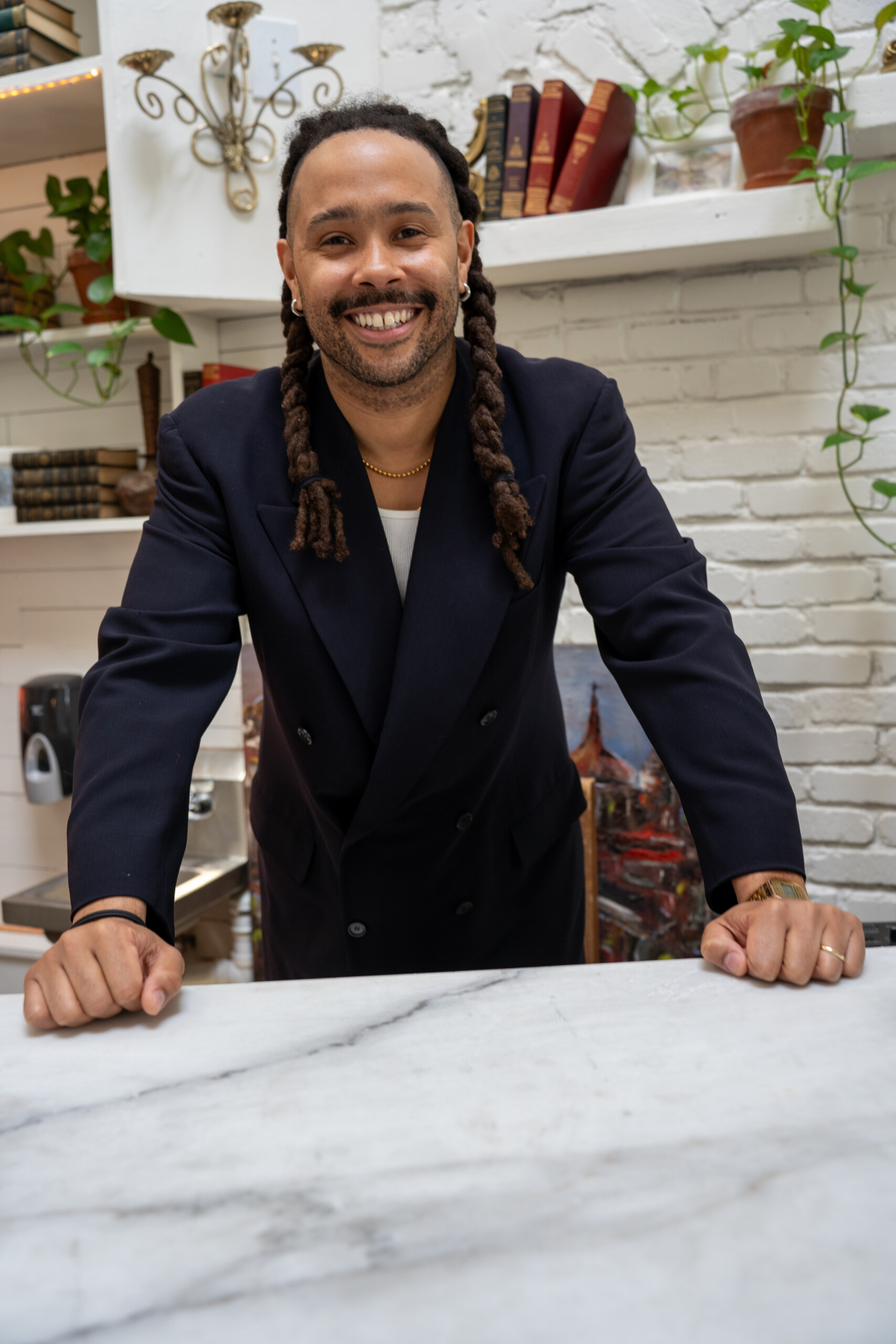
Bartender Michael Silva. Photo by @lpwasthere.
MICHAEL: When I first started going to The Eddy, I had no clue what I was doing as a patron. I was about twenty-three or twenty-four at the time and that was like 2014. Cocktails and bartending hadn’t even entered my vernacular yet, and it for sure wasn’t something I was thinking about for as a career. I moved to NYC for an education job on 2015 and took a part time job bar backing at a swank little cocktail bar on in East Village called Wisemen (RIP). Upon my return back to Rhode Island, I had caught the cocktail bug and was diving in full time. Obviously The Eddy was the place. I had landed a job at The Dorrance & then Cook & Brown, which is funny to think about because I, too, was coming up in the same places that the greats had come from (Jesse, Jen, Horus). I desperately wanted to be like them, but I was intimidated and never really thought I’d have the opportunity to work at The Eddy. Even after all of my “acclaimed success” with BĀS, The Dean Bar, booth., I still felt like I could never reach this proverbial White Horse that was hard to catch but I knew in the back of my mind as I constructed my career that The Eddy was the standard I was chasing.
A lot has changed for me since the birth of my daughter, but it has allowed me to focus on what matters. Post The Dean I was searching for a real home and just somehow reached out to Jen looking for a job and she brought me right on. I marveled her from afar and I prefer to work with women leadership. What I didn’t know is that people pay attention to other folks who care about this and she welcomed me with open arms. Being at this bar now, when I look at the cast that came before me, and the cast I have the pleasure and honor of working alongside now; I am without a doubt working at one of the best American Bar programs ever. And it’s all because of Jen, who is the “Fairy God Mother.” I have a duty to carry on greatness, but I also know that I needed to be here so bad. I needed to learn from Jen and co. because the bar hospitality scene is something I will most likely be doing for the rest of my life. Being on this team now, and being one of the faces of the program at the moment, I needed to get better at every aspect of my job. This place has allowed me to do that. They’ve accepted me for who I am, but it almost felt like they were waiting for the moment to take me. It’s been a happy marriage ever since and I’m blessed to be mentioned with this program.