A Portsmouth resident lost her husband and father to dementia. Now she advocates for caregivers.
Katie Brandt will share her story at the Alzheimer’s & Caregiving Educational Conference in Providence on June 17.

Katie Brandt pictured with her husband, Mike, and their son, Noah (age three), one year before Mike’s passing due to frontotemporal dementia. (Photos courtesy of Katie Brandt)
The first thing Katie Brandt noticed were the personality changes.
Her husband, Mike, had always been warm and gregarious, with many friends. The couple met in college and lived in New Hampshire, where Mike was a teacher. Brandt, who worked in the child welfare field, was pregnant, and they were expecting their first child, a son they would later name Noah.
When Mike was in his late twenties, however, Brandt began to notice changes in her husband’s behavior. Once outgoing, Mike seemed to withdraw from his social circle and keep to himself. On one occasion, he met a friend at a bar, only to leave abruptly eight minutes after he arrived.
“I just noticed, socially, he was becoming more and more isolated,” she recalls. “I began to get phone calls from his friends saying, ‘Is Mike mad at me, did I do something?’
His behavior changed at home, too. Brandt noticed Mike didn’t want to spend time with her and didn’t seem excited about their new baby. Once financially responsible, he became impulsive, racking up $28,000 in credit card debt over a short period of time. Several doctors attributed the changes to depression or stress.
“I had to take Mike to eight different medical and mental health professionals before he was accurately diagnosed,” Brandt says.
Finally, a month before Noah’s first birthday, they received an answer: Mike had frontotemporal dementia, a form of early onset dementia that affects the part of the brain controlling functions such as personality, communication and impulse control. The disease most commonly appears between the ages of forty and sixty-five, though Mike was only twenty-nine when he was diagnosed. Like with most forms of dementia, there is no cure.
“I was completely unprepared. I had never heard of FTD before, and I did not know that young people could get diseases that lead to dementia,” Brandt says.
The diagnosis was just the beginning of the family’s life-altering experience. Less than a week after receiving it, Brandt’s mom had a heart attack and died suddenly. Seventeen days later, her father was diagnosed with Alzheimer’s disease at the age of fifty-nine. Brandt left her job to become a full-time caregiver for her husband, father and infant son. In 2012, Mike died of FTD at the age of thirty-three.
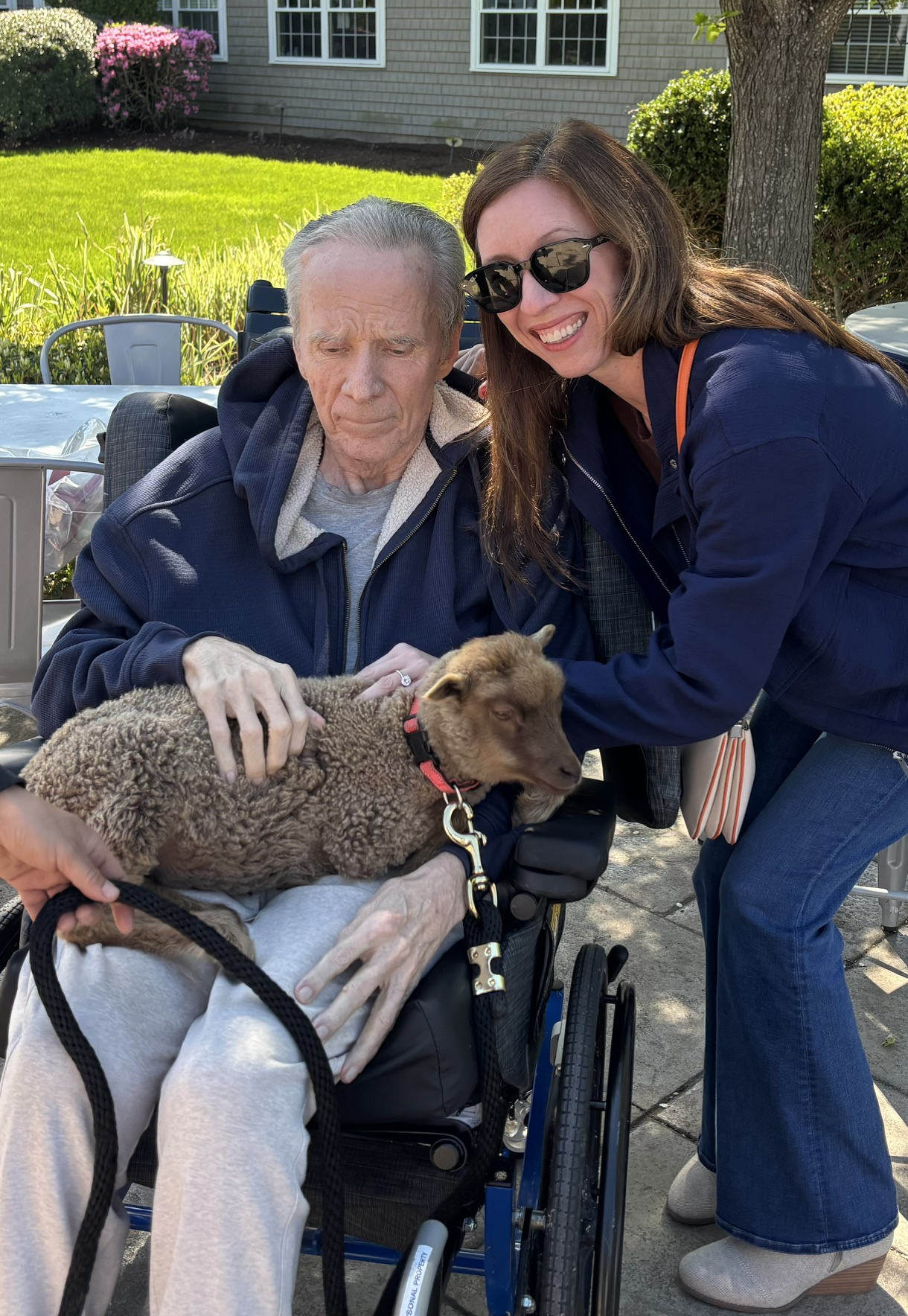
Brandt’s dad, who has Alzheimer’s disease, lives in a skilled nursing facility. Here, they enjoy time with animals from a nearby farm during a visit.
Aside from the heartbreak of losing her husband to dementia and watching her father battle Alzheimer’s, Brandt was left financially devastated by the diagnoses. She lost her house to foreclosure and relocated to Massachusetts, where she’d grown up. She spent her retirement savings to cover basic expenses and relied on social safety net programs like Medicaid and food stamps to make ends meet.
“I don’t think that a family should have to choose to live in poverty in order to meet care needs,” she says. “That’s why the work that I do today at Mass General and in the public policy arena is so important to me to be an advocate on behalf of families walking with dementia today.”
Today, Brandt is the director of caregiver support services for the FTD unit at Massachusetts General Hospital, the same unit where her husband received care. In addition to working directly with families, she serves as an advocate and educator for caregivers of patients with dementia, testifying before elected officials and speaking at events around the country. This includes the upcoming Alzheimer’s & Caregiving Educational Conference, a free conference for families affected by dementia coming to Providence on June 17.
According to Brandt, the conference focuses on education, information and connection, offering a space where people can learn about dementia-related diseases and connect with others in the community. In particular, she emphasizes the importance of connecting with other caregivers, who are more likely to live in poverty and experience isolation because of the daily realities of the disease.
“It’s so important that when you’re making a plan of care for your loved one, you’re making a plan of care for yourself,” she says. “One thing we know for sure is we don’t have a cure today for Alzheimer’s or dementia. But we do have a cure for the isolation and loneliness that comes along with the disease.”
For Brandt, the upcoming event presents an opportunity to share her story close to home. In 2021, after her work with Mass General became remote due to the pandemic, she followed a friend to Portsmouth. Rhode Island is now her home base as she travels for her advocacy work. Noah, now eighteen, often joins her in advocating and sharing his father’s story.
“His whole life has really been impacted by dementia,” she says.
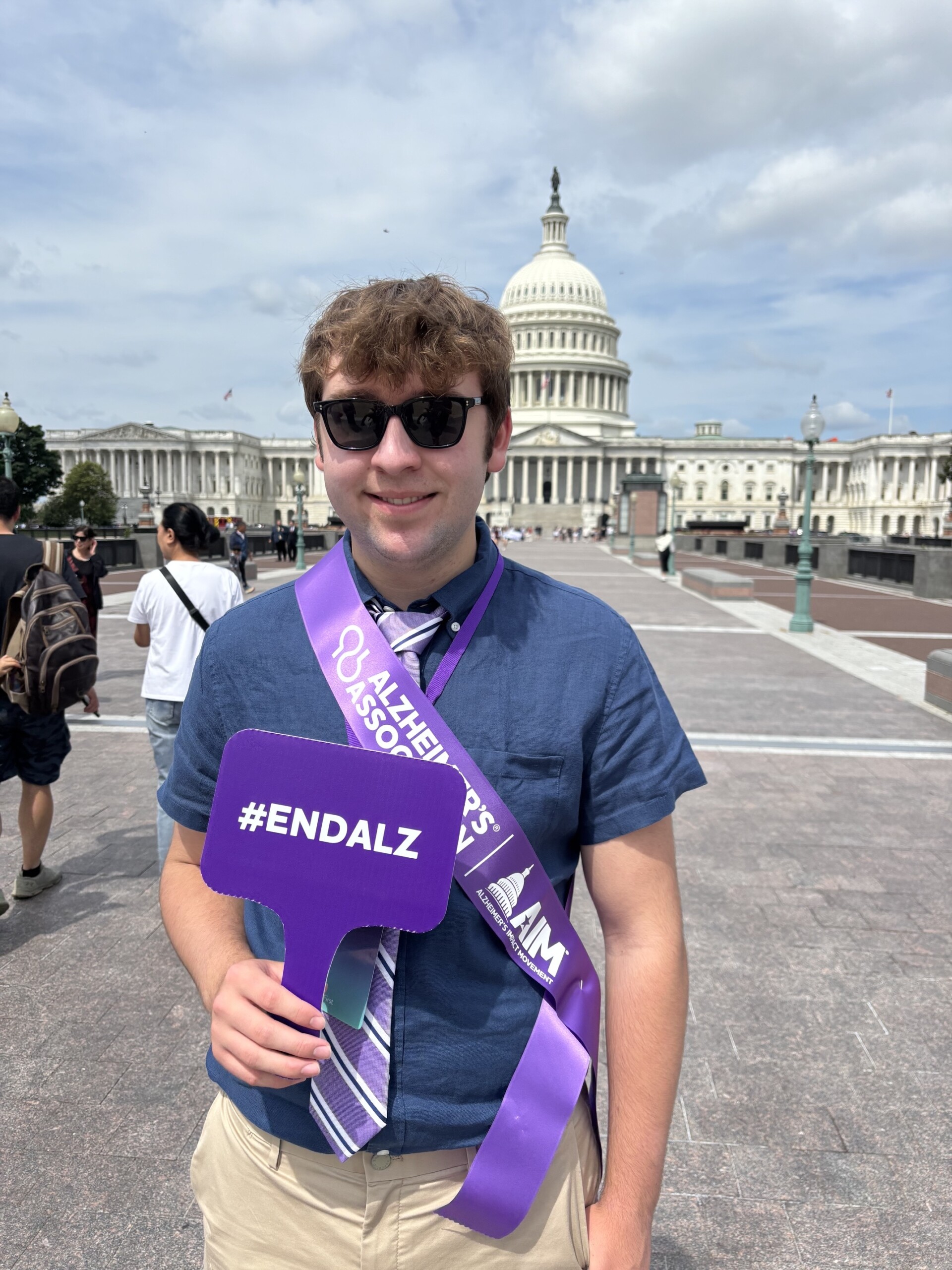
Noah Brandt, a senior at Portsmouth High School, attends the 2025 National Alzheimer’s Advocacy Forum in Washington D.C. to share his experience losing his dad to FTD and caregiving for his grandfather with Alzheimer’s disease.
Although awareness of the disease has increased — Brandt credits actor Bruce Willis and his family for being open about his battle with FTD — caregivers still struggle with the financial and emotional realities of dementia. She encourages caregivers to attend the conference for fellowship and practical advice.
“It’s a really warm, caring community, and I promise that if you come, you’ll leave feeling better than you arrived,” she says.
Other speakers at the conference include Bess Frost, director of the Center for Alzheimer’s Disease Research at Brown University, who will speak on current research in the Alzheimer’s field and the importance of clinical trials. Laurie Gunter Mantz, founder and CEO of Dementia Training for Life, will offer practical guidance for helping loved ones with Alzheimer’s retain their independence while staying safe.
The conference is sponsored by the Alzheimer’s Foundation of America and takes place at the Omni Providence Hotel from 10 a.m. to 1 p.m. Participants can register for free on the foundation’s website. More information is available at www.alzfdn.org.
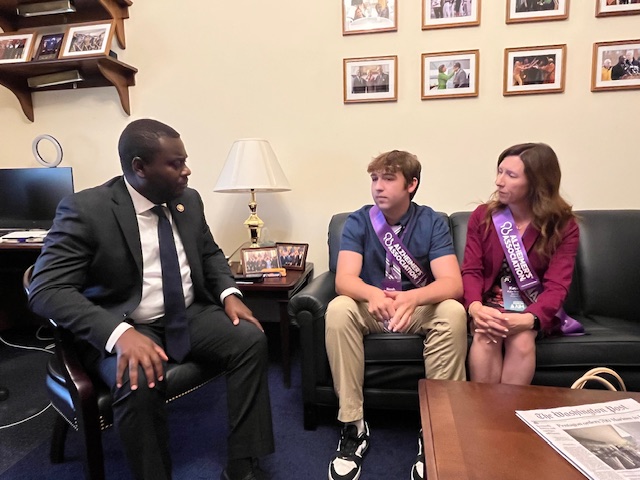
Katie and Noah Brandt meet with Rep. Gabe Amo during the 2025 National Alzheimer’s Advocacy Forum.