How Local Café Employees are Filling Their Cups
Staffers at three Rhode Island cafes have formed unions since 2020, with the trend showing no signs of stopping.

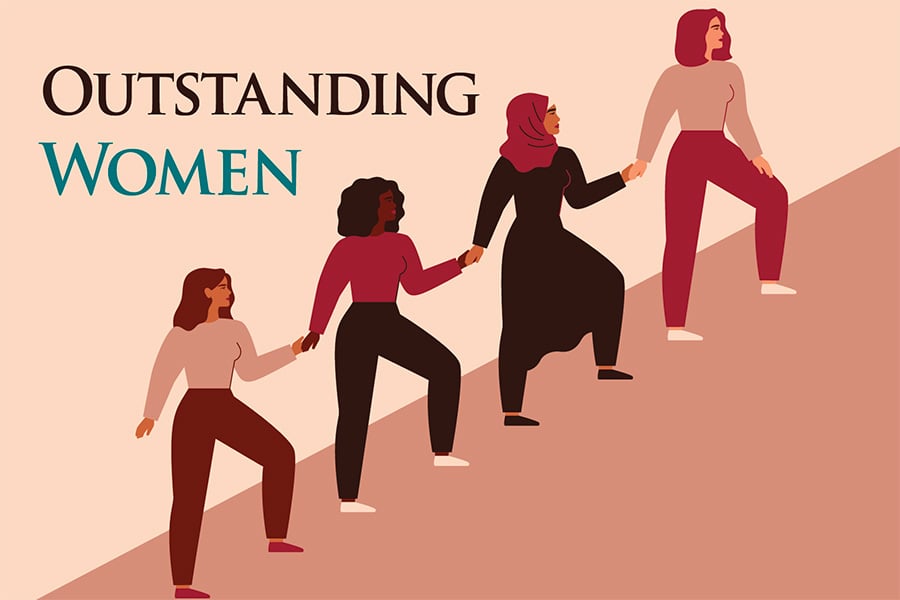
Illustration: Alan DiPetrillo
In June, Starbucks Store 27290 became Starbucks Workers United Store 703. The twenty employees at Providence’s University Heights location voted to join the grassroots union that sprang up at a Buffalo, New York, Starbucks nearly five years ago. When a colleague first approached barista Skylar Colon about organizing, the twenty-year-old knew little about unions; she knew plenty about what needed to change in her workplace.
“For starters, more staffing, also better pay,” she says. “I thought it was an amazing idea, because I realized that I don’t have to get used to the way things are. I can fight as part of the whole for things that we need collectively. When you’re in a union, you’re working together for a brighter future for all.”
Since May 2020, staffers at three cafes in Rhode Island have sought a brighter future through collective action. White Electric Coffee in Providence was the first, voting to unionize six years ago. Seven Stars Bakery baristas from all locations joined the United Food and Commercial Workers Union Local 328 in 2022 and ratified their second contract in January. The first Rhode Island Starbucks to unionize in downtown Providence unanimously voted to form a bargaining unit in 2023. (In February 2025, the workers at a fourth cafe with multiple Providence locations, Ceremony, initiated talks with the UFCW, but the attempt to organize fizzled.)
“To say [that unionizing] was utterly transformative would be an understatement,” says Andrew Wojcicki, a Seven Stars shift supervisor at the chain’s East Providence location. “I was lucky enough to be among those who organized at Seven Stars, to bargain for the first contracts, and then we really got to see and hear the fruits of that labor.”
The rise of the coffee shop union shop has stirred interest at a time when union density is at an all-time low. Only 10 percent of wage and salary workers — 14.7 million Americans — belonged to a union in 2025, according to the United States Bureau of Labor Statistics. At their most recent peak in 1954, unions represented 35 percent of the nonagricultural workforce. Rhode Island has the nation’s fifth highest union density at 16 percent.
Labor scholars and economists had long written off the food and drink services sector — with one of the lowest union rates of 1.8 percent — as too transient, too atomized and too low-wage to successfully organize. But the nationwide and growing Starbucks Workers United movement has inspired new analyses of its impetus, its wider effects and what this means for the labor movement in general.
“Ever since the 1980s, the mood’s been quite gloomy with labor, especially the way it’s reported in the media: It’s all been about decline. So, this resurgence has been quite a shift,” says Timothy Minchin, a history professor at La Trobe University in Melbourne, Australia, who has written about Starbucks. “Prior to this, the received wisdom was: Organizing is really hard. You have to have a lot of organizers, throw a lot of money at it, and it takes a lot of time. [Starbucks Workers United] threw a lot of that out. They did it themselves largely. They didn’t have a lot of them, and the central organizers used social media to mobilize very quickly. So, this has epitomized a new genre of [worker-
to-worker] organizing.”
The roots of coffee shop unions go back to 1900, when Seattle waitresses formed the first local. Then, as now, waitressing was considered unskilled labor, and women in food service were relegated to the lowest-paid positions, such as working in coffee shops. But they rejected that label. Unionized waitresses positioned themselves as skilled practitioners of a craft that relied on social skills to build bonds with their customers, leveraging that argument and patron support to get better pay and working conditions. In the 1940s and 1950s, all-female waitress unions represented nearly one-fourth of the trade nationally, according to Dishing it Out, a history of the movement by labor scholar Dorothy Sue Cobble.
Waitress unions petered out in the 1970s, when some were absorbed by the national Hotel Employees and Restaurant Employees International Union. But the industry shift from small independent eateries to chain restaurants that prioritized efficiency over personal service, staffed by a majority of part-time employees who earned income from tips, and a post-World War II turn against organized labor in general were the real killers.
The COVID-19 pandemic revived service sector unionism, as frontline workers found themselves jobless, or placed in harm’s way without any protections. The 2021 “Great Resignation,” where 4.5 million workers dropped out of the labor market, created shortages that fueled a recent high of work stoppages and petitions for National Labor Relations Board recognition.
Payday Report’s COVID-19 Strike Wave Interactive Map tallied nearly 1,200 strikes nationwide in 2021. In 2024, the NLRB received 3,286 union election petitions, more than double 2021’s total. Chloe Chassaing, forty-nine, a worker-owner of White Electric Coffee, says that the pandemic provided “a seed of inspiration” for the staff.
“A lot of workplaces were shut down, ours included. Myself and a few other co-workers were talking about issues at work that maybe we hadn’t had the space to think about prior. With the murder of George Floyd and the Black Lives Matter movement, there was a lot of reckoning happening and reflection of the status quo. So, we ended up writing a letter to our boss, outlining some of our grievances.”
The list included social justice demands, such as hiring more people of color, and more typical asks, such as raising wages. The majority of the staff signed on. It was an emotionally heightened time, Chassaing recalls, when a novel and deadly contagion was forcing people to isolate. But the group kept meeting outside in Dexter Park. They formed an independent union, called the Collaborative Union of Providence Service Workers, and bypassed a formal election and certification by the NLRB.
Like the waitresses before them, CUPS rallied customers to their cause. Owner Thomas Toupin agreed to voluntarily recognize CUPS, but listed the cafe for sale on the same day. He offered the staff the first opportunity to purchase it. One GoFundMe campaign and several fundraisers later, the employees scratched up $500,000 to buy White Electric. In May 2021, the cafe re-opened as an employee-
owned co-op.
“We were the first successfully unionized coffee shop in Rhode Island history, which is a cool thing,” Chassaing says. “Even cooler is seeing how much things have changed in five and a half years. People don’t even care about what we did because there’s so many [coffee shop unions], and it’s growing.”
And growing beyond food service jobs, says Zachary Schaller, an assistant professor of economics at Colorado State University. In February, Schaller and two co-authors published an analysis of Starbucks Workers United’s effect on unionization in general. Their county-level examination of union activity after a Starbucks location voted to organize found that “the Starbucks campaign had a substantial causal effect. And to the extent that we can measure that, it can explain about 20 percent of the non-Starbucks unionization wave, which is a pretty powerful effect for of one big campaign,” he says. “An interesting surprise of the study was that it was not concentrated in food service. We saw a little spillover there, but we saw mostly it happening in other industries.”
And what if the wave got bigger? In July, the Washington, D.C.-based Economic Policy Institute released a report estimating that union density at 30 percent would result in sweeping societal change: 14.5 percent wage increases for all workers in every state, averaging $7,700 more annually for the median worker; a significant decrease in income inequality, shifting $1.2 trillion to workers annually; a narrowed racial wage gap; an increase in the number of Americans with health insurance; and greater civic participation.
“A lot of our research points to the reality that unionization has been probably the most effective vehicle historically for workers to transform their individual conditions within a particular workplace, but also to broadly reshape imbalances of power in the economy,” says Jennifer Sherer, deputy director of EPI’s Economic Analysis and Research Network. “This report tries to analyze what’s happening in the world as it is, and produce a vision of what the world could look like under different conditions.”
Experts say getting to that worker’s paradise would probably necessitate changing federal labor laws. The most recent effort is the Faster Labor Contracts Act, a bipartisan bill which would mandate roughly a four-month deadline for a new union and employer to reach an initial collective bargaining agreement. If the parties fail to strike a deal, a federal arbitration panel would set the contract’s terms.
“Historically, the last three attempts to reform labor laws have crashed and burned. Our minimum wage is still so low, and workers just have not had much federal support in a long time,” says Nat Baldino, a senior policy analyst for the Center for Law and Social Policy.
“But states can play a big role. There are a lot of efforts of step in and be the Department of Labor or the NLRB in the absence of them. [State] trigger laws protect private sector workers, so if a federal labor law is repealed, it automatically triggers state protection.”
For example, in 2025, Rhode Island passed a trigger law to protect the collective bargaining rights of student workers at private universities, expanding the definition of “employee” to include “teaching assistants, research assistants, fellows, residential assistants and proctors” “when not already protected” by the NLRB.
In the absence of a balanced legal framework, some workers have DIY’ed it. Jasmine Leli, a barista in Buffalo who sits on SBWU’s negotiating team, is undaunted by the glacial pace of contract talks. Already, workers have won credit card tipping and expanded parental leave benefits.
“The company was never going to give us those things out of the kindness of their heart. We fought for them,” she says. And after five years, SBWU has alleged, Starbucks has racked up hundreds of labor law violations, paid millions in penalties and SBWU is still fighting for consistent hours, benefits and pay raises that don’t force workers “to choose between putting gas in your car and eating,” Leli adds. “That is something that baristas face every single day, while we have a CEO who is getting paid thousands of dollars an hour … while cutting the transportation benefit for workers.”
A Starbucks spokesman says the company “has continued to bargain in good faith, putting forward comprehensive proposals that build on our competitive pay and industry-leading benefits, which average more than $30 an hour for eligible hourly partners. Throughout negotiations, we have remained focused on reaching agreements that support partners and strengthen the Starbucks experience.”
“After over 700 elections, you would think they’d realize that we’re not slowing down,” says Leli. “I don’t know what’s in their head, but I know what’s in mine, and that is winning this contract.”
Minchin and Schaller agree that worker sentiment is not going away — despite the structural barriers and an active antiunion industry of lawyers and consultants who help employers discourage organizing and break up unions. A Gallup poll in 2025 found that nearly 70 percent of Americans approve of unions.
“Wait and delay. It’s a war of attrition where corporations have huge advantages,” Schaller says. “Starbucks is the first real uptick in organizing, at least, that we’ve seen in a long time, so I don’t think it’s just a blip on the radar.”
“The desire for a better deal and people’s interest in representation is going to stay because the long-term problems are huge: income inequality and the cost of living, these things have been building up for a long time,” Minchin says.
On a summer Saturday, Seven Stars Barista Stephanie Walker sat at the clean expanse of table in the window of the Cranston location. The coffee shop was thinly populated in the lull between the lunch rush and customers seeking a late afternoon pick-me-up. Walker had just finished her shift, and was only two weeks away from taking maternity leave. Walker, part of the negotiating team for the ninety-member unit, leaves with confidence that her employment is protected.
“It definitely helps with my security here because I know that my life is about to change,” she says.
Walker has worked for the local chain since her sophomore year at the University of Rhode Island, where she studied human development and family science. Walker became a full-time employee after graduation, because baristas, it turned out, made more than daycare workers.
During her eleven-year tenure, Walker has seen the benefits and the path for advancement progress at Seven Stars, and then halt after the pandemic. She says her attempts to get management to address these issues failed, and it was at this very table, she mused, where she explained to a perplexed manager why the staff joined the UFCW.
“Steph, why didn’t you tell me everyone was so upset?” she recalls him asking.
“I told you,” she said. “You didn’t listen.”
___________________________________
Ellen Liberman is an award-winning journalist and columnist who has commented on politics and reported on government affairs for more than four decades.