The Great Race
Rhode Island lays claim to some of the best young laser sailors in the country, but in a nail-biting competition between the national champ and a gifted challenger, who will win?
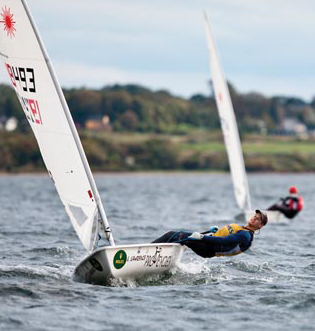
On the back of his left hand, Luke Lawrence had written a message to himself in smudged black ink: “Cash Check Bank of America.” The check was for $3,000, money that Luke earned last summer for ten days of work in Scotland, where he taught Team USA’s youth sailing team the finer points of sailboat racing.
Besides the three grand, Luke pocketed another $500 in tips, “because,” he says, “I did such a good job with the kids, opened their eyes to a whole new level of sailing.”
Luke, a confident nineteen-year-old with a superhero’s muscled good looks, arrived for his freshman year at Roger Williams University in September, carrying a fat scrapbook of newspaper clippings about his stellar career as the best single-handed high school sailboat racer in the nation.
Cy Thompson, a collegiate All-American in sailing and a veteran member of the Roger Williams sailing team, was not overly impressed with the new recruit. “He’s a good kid, but his cockiness,” Cy said of Luke — and then he left the sentence unfinished.
Cy began the school year as the defending national champion in collegiate laser class sailing, in which solo sailors skipper small, fast boats around a course like chariot racers on water. In fact, one of the reasons that Luke Lawrence chose to enroll at Roger Williams was because Cy Thompson was there. Almost as soon as he dropped his bags in his dorm room, Luke called Cy to see if he wanted to go laser sailing; he didn’t. But the new kid kept pestering.
“In between classes he’s calling me and asking: `Do you want to go laser sailing?’ I’m like: ‘Dude, relax,’ ” Cy recalls while sitting in an Adirondack chair on a hill overlooking the Roger Williams docks. “Call me about something else, but don’t call me to go laser sailing. We’ll practice at practice.”
Luke confirms the exchange. “It was kind of annoying that he really didn’t want to practice that much,” Luke says. “It’s cool that we’re both on the same team — but I wanted to push him, and I wanted him to push me.”
And therein lies the difference between Luke Lawrence and Cy Thompson. Both are championship caliber sailors, but Luke, a flaxen-haired Floridian brimming with energy, likes to push and be pushed.
Cy, a laidback islander from St. Thomas who admits to having “a problem with authority” won’t stand to be pushed by anyone, let alone a naïve freshman.
Luke is like a golden retriever with a boundless, obsessive energy for sailing.
Cy is more cat-like in appearance and demeanor: his hair is cropped, he’s leaner, quieter, prefers to be left alone — but in his own diffident way he’s at least as competitive, smoldering to win.
These two Roger Williams students are teammates when it comes to team sailing. But laser boats are solo boats and only one man can be national champion. Last fall, Cy intended to defend his title; Luke intended to take it away.
Before either sailor could worry about winning the national championship in Corpus Christi, Texas, he first needed to qualify for that final regatta. As fate had it, the Northeast Qualifiers would be held in mid-October at Roger Williams University, which has acres and acres of prime waterfront property on Mount Hope Bay. Nearly two-dozen laser sailors from New Haven to Hanover would converge at the Bristol campus for the national qualifiers; only four would survive the cut.
Hundreds of universities throughout North America fund sailboat racing teams, but Rhode Island, long a sailing Mecca, is particularly good at collegiate sail racing. At one point last fall, Rhode Island boasted three of the top eleven ranked teams on the continent: Roger Williams, Brown and Salve Regina. Roger Williams ranked as high as number two, Brown, three, Salve, eleven. The University of Rhode Island ranked twentieth.
“Being a sailor in Newport is like being an actor in Hollywood,” says Amanda Callahan, the Roger Williams coach and herself a world-class sailor. She says this as she heads toward the docks at Sail Newport, ground-up quahog shells crunching underfoot. This day she has brought her Roger Williams team to Newport for a scrimmage of sorts against Salve Regina, which owns a fleet of 420s, two-person sailing dinghies that draw their name from their length — 4.2 meters, or thirteen-feet, nine-inches long. Every collegiate team needs to know how to race and win with these boats, so Amanda has brought her team down for the practice.
As she passes from the parking lot to the boats, Amanda, a whippet-thin twenty-eight-year-old with green eyes and brown, sun-bleached hair, is greeted like a rock star — almost everybody in the boatyard on this offseason day knows who she is. Besides being a former All American sailor at Hobart and William Smith College in upstate New York, she is a member of Team Silver Panda, a six-person team of sailors that in the 2007 season won all three of the world’s major team sailing championships. She took over the Roger Williams program three years ago, wooed back east from an assistant coaching job at Stanford after Roger Williams recruiters told her they were trying to make sailing the school’s “signature sport.”
Amanda carries a bullhorn with her in her coach’s boat, on this day a borrowed Boston Whaler, but she doesn’t really need it. For a little person — she stands only five-feet, three-inches tall — she’s got a big voice.
“Addie!” she shouts to Adrienne White, a freshman woman on what is a co-ed team who’s sailing in one of the 420s in Newport Harbor. “A little more snappy with your upper torso! It should be like — uh!” Amanda grunts while demonstrating by snapping her upper body out over the gunnels of her boat. “Know what I’m saying?”
From the center console of her coach’s boat, Amanda stares through sunglasses at the fleet of sailboats circling a course between the arcing Newport Bridge and the green lawn of Fort Adams. The boats look pretty, the low sun of a fall afternoon striking their sails, illuminating the numbers stenciled on each boat in the yellow, red and green hues of billiard balls. The beauty of Newport Harbor is not lost on Amanda. “I wish I had a camera right now,” she says. “The color for pictures is unreal.” But she’s not out there for the scenery; as she steers her boat she’s like a shark looking for weak fish, and when she sees a weakness she pounces.
“Ryan,” she shouts to Ryan Saraiva, a freshman from Bermuda, “You’re, like, real mellow in your movements. But a 420 needs to be a lot more kinetic — I need you to actively push the boat over in the roll!”
This is not an official race, but clearly the best boat this day sports a root-beer-colored number twenty on its sail. Every time the air horn blows, signaling the start of a race, number twenty is first off the line, and no one ever reels it in. The skipper of that boat is from Salve, but Amanda knows who he is.
“That’s Patrick Clancy,” she says. “I went to high school with his sis-ter,” at Notre Dame Academy in Scituate, Massachusetts. “His brother went to Hobart and is the coach at the Naval Academy in Annapolis.”
While Patrick Clancy’s topping the field, Luke Lawrence is having a hard time plowing around the harbor as skipper of a 420. The sun’s barely perched above Beavertail, humped to the west, and a chill is settling in as Luke sails within hailing distance of Amanda’s boat.
“I’m starving,” he says. “My hands are cold. I’m not happy. Amanda,” he jokes, “do something about it.”
“Whah, whah, whah, whah.” She mimics a crying baby. She makes Luke sail a few more practice races before pulling him out of his boat into hers. “Hi Amanda,” he says as he clambers aboard. “I haven’t eaten a thing all day.”
“That’s poor preparation, Luke,” she scolds. In Amanda Callahan’s view, nothing is more sinful in sailing than poor preparation. “Failing to prepare,” she sometimes says, “is preparing to fail.”
With daylight draining from the sky the fleet is given the signal to head for the docks, where the Salve Regina team has set up a grill to share sizzling burgers and hot dogs with their guests. As they steer their boats to shore, the collegiate sailors have a rare chance to relax — the wind blows from their backs, pushing them along toward the promise of a hot supper. Amanda drives her boat up to boat number six, skippered by Cameron Pimental and crewed by another freshman, Addie White.
“Come on,” Amanda says, culling their boat from the fleet. “Let’s go practice tacks and jibes.” At the end of a long day, with darkness creeping in and supper waiting, this is the last thing Cameron and Addie want to do.
“Go pick on someone else!” Cameron yells, but he obeys, steering his boat into open water. With the wind at his back he whips the sails from starboard to port and the boat reacts violently; he and Addie pop up like gophers to perch on the high side of the heeling boat then lean out over the rails to bring it back to even keel. They do this again, and again, and again. Amanda does not like what she sees. She pulls Addie aboard her boat and jumps into the racing dinghy to demonstrate proper technique, popping from rail to rail with graceful fluidity.
“I can’t do that,” Addie mutters. “Yet.”

Luke Lawrence Cy Thompson Amanda Callahan

Amanda again swaps places with Addie, studying her technique. In the gloaming, Cameron and Addie grow tired and listless; they clumsily go through the motions of tacking the boat.
“What are you guys doing to go above and beyond right now?” Amanda shouts. “Nothing. Again!”
Cy Thompson acknowledges a “tension” between himself and his coach, Amanda Callahan. “I hate being told what to do all the time,” he says while sitting shirtless on a hill perched above Mount Hope Bay, a diamond stud in his ear. “She really knows how to push my buttons and she does it, sometimes, I think, on purpose.”
Still, Cy concedes about Amanda, “She’s no idiot. She’s definitely been around sailing quite a bit. She knows how it all works. Her and Colin [assistant coach Colin Merrick, a former three-time All-American], they’re the best team racers in the world right now.”
Cy Thompson has also been around sailing quite a bit. Soon after he learned to walk he learned to sail, tutored by a mother and father who used to dominate windsurfing races throughout the Caribbean. At five years old, Cy sailed solo around the main harbor in his native St.
Thomas, U.S. Virgin Islands. He had such a blast that he invited all his little buddies to accompany him on future trips, much to the delight of tourists who snapped photos of the tow-headed skipper and his gang, barely big enough to peek above the gunnels of the boat.
During a year-long break from college, he held a job teaching wind surfing at St. Thomas’s Ritz Carlton. “One of the best jobs I’ve ever had,” he says wistfully. “The girls there were unreal.”
With an upbringing like that, sailboat racing has come easily for Cy. “I was born into sailing, kind of,” he says. “I kind of just see stuff and figure it out.” He’s able to look at the water and see things most of us won’t see — not only the approaching ripples of a wind gust but the ripples behind that, and more behind that, and the connections that might link them together.
“He makes the little, subtle corrections of someone who has a really good feel for what he’s doing,” says Colin Merrick, the part-time Roger Williams coach.
“He’s really talented,” Amanda agrees. “He’s got a real feel for it. The other thing that makes Cy real good — actually, his work ethic is really bad, but his confidence and his determination to win things” have thus far been able to compensate for his lack of commitment to training.
Cy is one of those people who is candid to a fault. For example, he tells me, the week before the big race that would determine qualifiers for the national tournament, he and his roommate got booted off campus for seven days as punishment for
a party they had held — something about two dozen people bailing out of his second-story bedroom window when the campus cops came knocking.
Though he’s twenty-one years old and has sailed in competitions around the globe, Cy still acts like a kid away from home for the first time. “I mature slower,” he acknowledges. “I’m still in the ‘It’s college, have fun,’ phase. Sailing will always be there.”
He knows it must be aggravating for coaches and competitors to see such a natural talent go unsharpened, but he believes in doing things his way and so far it has paid off — after all, he did win the national collegiate laser sailing championship in 2008, and he saw no reason to change things for 2009.
“There’s definitely people who have worked harder for it than me,” Cy said. “I never really had a coach when I was growing up. It was really more me out there by myself, doing my own exercise, hiking, getting my techniques down.
“I kind of like to work at my own pace and really do my own thing.”
If scientists manipulated gene-tics to create the perfect laser sailor they’d create a man who looks like Luke Lawrence. At six-feet-two, 200 pounds, he is the perfect height and weight for the boat — any heavier, and the boat would lose efficiency by sitting too deep in the water; any lighter and it’s hard for the sailor to “hike” out over the boat’s rails to keep it flat in the water. And a sailing mantra is “A flat boat is a fast boat.”
Luke grew up in Palm City, Florida, and though the wide St. Lucie River flowed past his backyard, he did not discover sailing until he enrolled in a summer camp at age twelve.
“I sucked,” he says of his first sailing experiences. “I was a typical summer camp kid just starting out.”
He didn’t stand out, but he loved sailing the camp’s laser boat. He came home from camp and, “I begged my mom for laser, laser, laser,” a $5,000 boat. His family runs a successful fence building business in Palm City; on his birthday that August, six years ago, thirteen-year-old Luke Lawrence looked in his backyard and saw a laser sitting on a trailer.
“I had no idea how to rig it.” But he figured it out. Books, he says, he’s not much good with, but give him a practical problem to solve with his hands and he’ll find a solution. After that, they couldn’t get him off the water. Three or four hours a day he’d be out on the wide St. Lucie, sailing his little laser. His mother, Gloria, hired a coach from the local yacht club and the coach showed him how to get more speed out of his boat.
By the time he was fourteen, Luke Lawrence stood six feet tall and weighed 180 pounds, nearly as big as the best men. He went to the Florida Keys for a sailing clinic where he caught the eye of a coach, Zach Railey, a silver medalist for the U.S. Olympic sail team. Railey, his sister Paige, and another coach sat down with Zach’s mom and said, in Luke’s recollection: “Your kid could be the best in the country within the next year if you let us take him and mold him.”
Mom said: Do it. And the next year Luke won the laser division of the Orange Bowl, a national race that annually draws 800 high school racers to Miami. “I was the youngest to win that in a long time,” Luke says in typically brash fashion. “The kid who finished second was seventeen”—Fred Strammer, now racing lasers for Brown.
Then came victory in the Cressy Cup, the high school national championship in his senior year, by which time Luke had filled out to 185 pounds on a six-foot-two-inch frame — the perfect dimensions for a laser sailor.
“I’m genetically gifted,” he says. “I’ve got a gift. I’ve been given a gift. I’ve got potential to be the best in the world, and I want to be the best in the world.”
Being the best in the world at anything is not easy, and for Luke sailing glory hasn’t come as easily as he’d sometimes like to project. In high school, his classmates thought his obsession was odd; “sailor boy,” they called him. His weekends were always consumed with training or competing, and as he got older the competitions took him to faraway places — Australia, Denmark, San Francisco. His mother supported him one hundred percent, ponying up travel money, pulling him from school for weeks at a time. “She’s been my biggest role model and my biggest fan,” Luke says of his mom.
In early 2008, Luke nearly lost it all. He was horsing around on a waterslide at a hotel in Australia, where he’d gone for the Laser Standard World Championship. He stood with one foot and one hand on each edge of the waterslide, forming a wicket that a friend would slide through. But as he slipped past Luke, the friend’s arm hit Luke’s left wrist; Luke plunged into the slide face first, smashing the side of his face. It knocked him out. He slid unconscious down the slide, coming to his senses at the bottom of the pool. He stood in waist-deep water, and waded to the ladder.
“I went to grab the ladder with both hands, and only my right arm went.” His left arm was dead and useless. His rotator cuff was paralyzed and he had pinched, nearly severed, a nerve in his neck.
Back home, a doctor told him it would be eighteen months before he’d sail again. “I wasn’t having any of that,” Luke recalls. After months of therapy he represented the USA at an event in Denmark featuring sailors from forty-five nations — and he won the silver medal. >>
“That was the turning point in my sailing,” Luke says of the neck injury that nearly left him paralyzed. “Now I think things through. Before, I just went and did them.”

Sometimes though, he still fails to think things through. In his first week on the Roger Williams campus he got bounced from campus housing for a week for drinking; and the weekend before the national qualifying event he and several teammates showed up for a regatta so hung over that the team sailed poorly and fell behind Brown in the national rankings. (Brown begins the spring season ranked third, Roger Williams seventh.)
“I set up a meeting with Amanda and apologized,” Luke says. “I wrote a two-page list of what to change to become a better person.” The list included stop striving for normal.
“I’ve always had a habit of trying to fit in and be an average Joe. But I know I’m a lot better than a lot of people as far as sailing goes. I want to stand out and be the best.”
Before he can do that he has to beat the reigning best laser sailor in collegiate sailing, Cy Thompson.
On a day so blustery that the National Weather Service issues gale warnings and advises small craft to stay off of Narragansett Bay, Amanda Callahan ignores the warnings — her sailing team needs to practice. She tells a half-dozen laser sailors, including Cy and Luke, to head south of the Mount Hope Bridge to practice by themselves while she supervises the rest of her team sailing in their FJs or “Flying Juniors,” two-person sailing dinghies barely longer than thirteen feet.
The Roger Williams coach’s boat is a worn out, beaten up Key Wester, a wide boat with a center console. As two of her sailors, Emerald Epke and Bianca Rom, whistle past in the high wind, Amanda calls out: “Don’t look so scared!”
“We’re not scared,” says Emerald, a junior from Tiverton — but they should be.
Amanda says, quietly, “I want to make somebody capsize.”
A sailor has to push a boat beyond its limits to learn its edge. Amanda shouts to the fleet that they’re going to practice jibes — swinging the sail from side to side in a following wind. Jibing a thirteen-foot dinghy in a gale can push it over its edge.
The first to flip are Emerald and Bianca. The water’s cold and choppy; Bianca’s just an inch above five feet tall and is light; the two struggle to right the boat as yard-high waves smack their faces. After watching for many minutes Amanda drives over to help them right the boat. By then others have capsized, then some more. At one point, half of the fleet of eighteen boats has turned turtle — including Emerald and Bianca for a second time. Amanda holds up an anemometer and measures a wind gust of 31 knots — nearly 35 miles per hour.
“Back to the beach,” she yells through her bullhorn. “Everyone back to the beach!”
With the fleet of FJs headed back toward the docks, Amanda points her boat toward the Mount Hope Bridge for a spray-soaked, tooth-rattling ride into the wind — she’s going to go put the laser sailors through their paces.
For the next hour or so she has them practicing starts and completing short races; some of the weaker sailors head back to the docks, but Cy and Luke push on. Amanda doesn’t like the look of Cy’s sailing. “He looks fatigued,” she says of Cy, who isn’t bothering to “hike” or lean way out over the rails to keep his boat flat in the waves. She’s worried about whether he’s trained hard enough to qualify for the nationals.
After one practice start, Cy announces he’s had enough — he’s heading back to the docks. “No,” she says. He turns around and practices some more. Then Luke sails near in a laser bearing the logos of his many sponsors and says he has broken his outhaul, a piece of equipment that adjusts the width of the sail. Amanda decides that they’ve practiced enough — back to the beach, she orders, and the little fleet of lasers sails beneath the Mount Hope Bridge.
Ashore, Luke confides that he hadn’t really broken anything, but he’d grown tired and was ready to come in.
Cy says that he was not as fatigued as he appeared to be; he was dogging it because he had just installed $300 worth of new equipment and did not want to break anything. Besides, he says, “I don’t know if Amanda told you this, but we’d never actually race in conditions like that.”
The forecast for the first day of race weekend calls for high winds aloft to mix down to the surface, generating gale force gusts. Luke’s excited about this forecast because high winds favor the bigger, stronger sailor.
But at 10:51 a.m., when the blast of the starting horn echoes over Mount Hope Bay, the wind is barely enough to ripple the water. Clouds scuttle low above the bridge, a telltale sign of high winds tantalizingly close, but just out of reach.
Luke gets a good start — and holds it. In his first qualifying race as a collegian, Luke Lawrence tops the field. Cy crosses the finish line, almost beneath the Mount Hope Bridge, in fourth place behind sailors from Yale (Thomas Barrows) and Brown (Fred Strammer.)
But there are eighteen more races to be run over the next two days, and Luke does not fare so well in the next two: He places ninth and sixth, giving him a three-race total of sixteen points; Cy has finished fourth, third, and third, a total of thirteen points — lowest score wins.
Between the third and fourth races the wind arrives as suddenly as a scene change in a theater. As the sailors jockey their little lasers around the coach’s boat a gust topping twenty miles per hour hits the fleet.
From the coach’s boat, Dan Rabin shouts to one of his Brown University sailors, “There were some narrow puffs on the right that never materialized. That’s all over now. The breeze is on for the rest of the day.”
The “breeze” steadily picks up, pushing swells that spill over into white caps. On the last race of the day the wind blasts from the west at more than thirty miles per hour — exactly the conditions that Cy claimed they’d never race in. As he rounds one of the pink plastic buoys marking the race course, Cy’s boat flips down on top of him, a capsize known as a death roll.
Cy comes up, clambers aboard and pilots his boat to a tenth-place finish on this, the last race of the day. As he sails past the race committee’s boat he shouts: “Amanda, I think I broke my leg!”
To Amanda, Cy looks “like he’s in a world of pain,” she says later. “Just the expression on his face,” which is pale and pinched. She sees that Cy doesn’t have his right leg under the hanging strap, a strap bolted to the boat’s floor so a sailor can stick his toes under it and hang over the rails.
“Cy!” she says. “What is going on?”
If Cy hears her he doesn’t let on.
He points his boat northward to the Roger Williams docks and sails away.
From her cell phone she calls the school’s athletic trainer and reports: “Cy just said that he thinks he broke his leg.”
The trainer, Josh King, is on the sidelines of a Roger Williams soccer game; by rule, he cannot leave that game until it is over, and there are nine minutes and twenty-nine seconds to go.
When the game ends, King drives down to the waterfront in a golf cart. He hauls Cy to his office for examination of his leg. Sitting in the trainer’s office, his right foot deep in a boot full of ice, Cy reports via cell phone:“I flipped down hard and it smacked against the inside cockpit.”
Will he sail the next day, or quit the regatta?
“If it hurts too much… I don’t know.”
From her phone Amanda says: “He’ll sail.”
The next day brings perfect conditions for laser sailing: winds blowing between fifteen and twenty miles per hour, blue skies, a light chop in the bay. Luke begins the day in second place only three points behind the leader, Thomas Barrows from Yale; Cy has a solid grasp on fourth place, the last position to qualify for the national race in Texas, but if he can’t sail he is out.
Cy, dressed in a dark wetsuit and yellow life vest, limps down to the waterfront and rigs his boat. The trainer has diagnosed his leg injury as a bad sprain, and Cy has decided to try and finish the regatta. He rolls the little trailer holding his boat to the water’s edge, kicks off the compression boot he’d slept in to reduce swelling, and sails out to join the fleet.
The starting horn blows — and Cy wins the first race. All that morning he sails incredibly well, taking a second-place finish, then a third, another third, another first. Though his ankle sprain is killing him, the injury makes him sail smarter races.
“It actually made me start thinking more instead of just being a typical laser meathead and just trying to manhandle my way across the course,” he later says.
The first-place finish puts him in front of Luke for third place, a position he never relinquishes. At the end of the day, Yale’s Thomas Barrows has finished first, Fred Strammer of Brown takes second, and Cy and Luke come in third and fourth — not as well as they were hoping to finish, but good enough for both of them to keep alive their dreams of a national championship.
Epilogue: At the national championships in Corpus Christi, Texas, Cy Thompson captured fifth place; Luke Lawrence came in eighth. “They were disappointed they didn’t do as well as they expected,” Amanda says. “But hey, fifth and eighth in the country isn’t bad.”
Eighth wasn’t bad, but it wasn’t good enough for Luke; in December he decided to leave collegiate sailing to train for the 2012 Olympics in London. Luke is moving up a weight class from the laser sailors to the Finn Class, a larger boat for bigger people. He plans to bulk up and hopes to make the U.S. Sailing Team in time for the next Olympics.
Cy is racing for Roger Williams’ top team in the team racing events this spring, which have already begun.
He has set his sights on helping the Hawks win a team championship at the Nationals this month.