
Living the High Risk Life
As she sailed the Caribbean and Europe, Newport commodity trader Liza Baldwin bet it all on a first-class lifestyle. Furious investors say her lavish ways cost them millions. Now they’re clamoring to get their deposits back, but is there any money left?
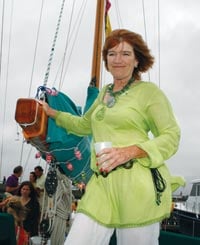
Standing at the bow of a sixty-five-foot yacht, Liza Baldwin was Queen of the World. Van Ki Pass, the mahogany sloop she chartered to compete in the 2006 centennial Newport to Bermuda race, had finished the 635-mile course in four days and twenty-three hours, beating fourteen other boats to scoop first place in its division.
As a girl watching the ships launch from her home port, Baldwin had dreamed of this moment. She was primed to celebrate with champagne toasts at an awards ceremony hosted by Princess Anne. Newport friends were waiting at the dock of The Fairmont Hamilton Princess Hotel in the seaport capital of Bermuda. Baldwin spoke to them and returned to the Van Ki Pass to fetch a few belongings. Then she disappeared.
When she was still MIA the next day, crew member Eric Sanford and Baldwin’s brother-in-law, Moe Dixon, notified Bermuda police that she was missing. They gave them her passport and laptop, thinking it might yield some clues.
“Some people thought Liza fled the island,” says Sanford. “Others feared she might have been killed because she owed people money. The police got marine divers to search the water. We didn’t know if she’d fallen overboard or committed suicide.”
Baldwin, who declined to be interviewed, was a trader who managed a commodity pool called The Newportant Group. The sixty-two-year-old represented that she had spent twenty-five years on Wall Street, at least fifteen of which involved futures trading. She told participants she would pool their money and use it to trade futures contracts on S&P 500 and ten-year note and thirty-year bond futures contracts electronically on the Chicago Mercantile Exchange.
Futures contracts are an agreement to buy or sell a commodity at a specific date in the future for a specific price. Fossil fuels, metals, agricultural products and financial instruments (such as stocks, bonds and currencies) are commonly traded commodities. Just like the price of grapes at the grocery store, the prices of commodities can shift on a weekly or even daily basis. If the price goes up, the buyer of the futures contract makes money because he gets the product at the lower, agreed-upon price and can now sell it at the higher market price. If the price goes down, the seller makes money because he can buy the commodity at the lower market price, and sell it to the buyer at the higher, agreed-upon price.
Baldwin told potential investors that monthly profits ranged from 3 to 10 percent and averaged 5 to 7 percent. Investor agreements stipulated that trading would terminate if the participant’s account lost 10 percent or more of its value, which assured customers that the pool wouldn’t drown them. Baldwin’s compensation would be half of the running net profits.
With a gregarious personality and gravity-defying looks, the redheaded divorcee made friends easily. They were friends with money whose tentacles brushed others in the right tax bracket. Her commodity group seemed popular and exclusive; Baldwin occasionally refused new members, telling them the pool was full but they could join if someone else dropped out. She had a certain aura, says Glenn McDermott, a Virginia Beach internist who invested $1.4 million. He was impressed by Baldwin’s cosmopolitan friends, who spoke of her trading acumen as they sipped cocktails aboard her yacht in St. Bart’s.
At one point, Baldwin was supposedly making $10,000 a minute trading on the Internet.
But she was a master of illusion. According to federal and state investigators, Baldwin siphoned $7.3 million from forty-seven investors around the world during a three-and-a-half-year period; she used the money to fund trading losses, cover personal expenses and pay back prior investors (all told there were about seventy-five). The U.S. Commodity Futures Trading Commission (CFTC) determined that the profits reported to investors were false: Baldwin actually suffered net trading losses in forty-three of the forty-four months between January 2004 and August 2007.
Michael and Leslie Foster, the Newport couple who confronted her at the dock in Bermuda, had seen the truth behind Oz’s curtain. They met Baldwin through a Newport friend who raved that Liza had made her millions—enough to retire. They had a seed of $138,000 on deposit with Baldwin for two-and-a half years; according to account statements, she had spun it into more than a million dollars. That spring before the race, Baldwin told the Fosters that she planned to take a hiatus from trading because it was too stressful. They asked to liquidate their account and she wrote them a check for $1.68 million, the net of their investment plus purported profits. Then she set sail. But her checking account was short on funds. So the Fosters were not at the finish line to congratulate Liza.
Dixon and Sanford spent two days on mopeds, searching the island for Baldwin. Liza, whose ex-husband is a retired Episcopalian minister, eventually contacted her twenty-something daughter in the States to say she was okay. After some telephone negotiations, Baldwin agreed to meet with her brother-in-law. While her family, crew and the police had done everything but scour the Bermuda Triangle, Baldwin was keeping a low profile at the Grotto Bay Beach Resort.
“She was at this $300-a-night villa while twelve crew members were eating eight-day-old food on the boat!” Sanford says. “It was mutiny. Liza had said she’d reimburse everyone for their flights to Newport and their tickets back home but we were stranded.”
Michael and Leslie Foster, however, had no intention of fending for themselves.
Life’s journey is not to arrive at the grave safely in a well preserved body but rather to skid in sideways, totally worn out, shouting “What a great ride!”
For months, this saying tailed Baldwin’s email messages. It seems prescient in the rearview mirror. Sailors tack from side to side to reach a destination—they can’t get there in a straight line. Some acquaintances speculate that perhaps Baldwin intended to walk the line but didn’t choose a linear route. “People who know Liza know that she would never intentionally screw anyone,” says a yachtie friend. “Investments are a gamble; those people took a risk. Anyone who has sailed with Liza knows how much fun she is so they got their money’s worth.”
Like sailing, futures trading is subject to tempests. It’s considered especially volatile because prices can change so abruptly. A commodity’s value responds to many unpredictable factors such as weather, labor strikes, inflation, foreign exchange rates and government monetary policies. “The commodity futures and option markets are very risky and you can lose your entire investment very quickly,” the U.S. Commodity Futures Trading Commission warns on its website. “Be wary of any firm or individual offering to trade your money in commodity futures or options, or to pool your money with other customers.”
 “I don’t know whether to call her dishonest or incompetent,” says Bernard Hummel, a Virginia Beach investor. He wonders if Baldwin hoped to recoup trading losses and eventually pay people back. Yet she didn’t downgrade her lifestyle in the meantime, flying first class and renting a house in St. Bart’s, among other extravagances. After the Newport-Bermuda race, an investigator says she used investors’ money to purchase the Van Ki Pass for $315,000. (It’s reportedly worth far more; the next year, it was offered for 1.2 million Euros by a boat broker.) Even family members were skeptical about how Liza could be successful enough to afford the lush life. “We don’t know and we don’t ask” was one relative’s attitude. An in-law said, “I don’t know what the hell she does!”
Investors can only speculate on Baldwin’s intentions. Yet many are certain they paid dearly for her great ride.
Back in Bermuda, Baldwin asked the Fosters to give her time. She said if they pressed charges, they wouldn’t get a dime [presumably because the authorities would freeze her assets]. With lawyers mediating for both sides, a payment plan was formulated.
The Fosters weren’t the only Newport family to receive a rubber check that summer. The same month as the race, William Heydt, an artist and landlord, asked to withdraw most of his investment to pay bills, taxes and his children’s tuition. Baldwin wrote him a check for $700,000 that was returned for insufficient funds. Heydt “did not wish her any personal or professional harm,” so he agreed to a payment plan instead of pressing charges.
Initially, Baldwin anted up. She stopped soon after arriving in St. Bart’s, where she rented a house for the winter and frequented the St. Bart Yacht Club. She then sailed to Spain for the America’s Cup race. She told Heydt it was difficult to wire money from Europe so she would resume payment when she returned to Newport that summer. In August 2007, Heydt (who declined to comment) asked for his remaining $580,000. Again, Baldwin’s check bounced. After learning that she planned to return to Europe that fall, he contacted Newport police, who arrested Baldwin for violating banking laws and took her passport so she couldn’t leave the country.
Like the rum and ginger beer drink popular with sailors, Liza’s life was about to turn “dark and stormy.”
In some ways this story could be read as a cautionary tale of the seven deadly sins: lust, gluttony, greed, sloth, wrath, envy and pride. It would open with envy. Elizabeth Carter Baldwin grew up in Newport, but she didn’t waltz at debutante balls in marble mansions. She attended St. Catherine Academy in Newport, a now-defunct parochial high school for girls. Her family was considered middle class by local standards, which afforded them a window view of what they had not.
Social climbing in Newport is rife with landmines, as the nouveaux riche can attest. People have bought homes there in hopes of joining the blueblood Bailey’s Beach. When membership—their social entree—is denied, some have fled town in shame.
Crossing the Newport Bridge, the sky is washed Mediterranean. Fictionalizing yourself seems plausible in that ethereal, newborn light. “Liza craves attention,” says Sanford. “She wants to be part of high society.” He watched Baldwin “in her glory” as she was photographed and interviewed after winning the Newport-Bermuda race.
Sanford says she even flew a stylist up from the Caribbean to trim the crew’s hair before they launched. “Marco” (whose clients include Bill and Hillary Clinton, according to Baldwin) snipped away on deck as fellow racers watched, green-eyed. She gravitated to larger-than-life characters. To captain the Van Ki Pass, she hired Randy West, an American expatriate from St. Bart’s with a legendary appetite for wine and women.
Like the name of her commodity pool, Baldwin aspired to be “Newportant.” But the Newportant Group was never registered and trading was done in her own name only. Her Commodity Pool Operator (CPO) registration expired in July 2005. The National Futures Association (NFA) requires that someone responsible for investing a pool’s assets in commodity futures be registered.
Several investors say that Baldwin indicated she was not required to register because she was operating a small pool. The Commodity Futures Trading Commission provides relief from registration as a CPO and NFA membership for a pool with no more than fifteen participants where gross capital contributions don’t exceed $400,000. However, that exemption must be filed with the NFA and Baldwin never received it.
Origins of the term “Newportant” are murky. It was supposedly coined to mean that the town is a “fantastic, unique place filled with interesting people,” but not necessarily social WASPs. Emily Hertzer, a Yale graduate who crewed in Newport, told The New Yorker that being Newportant means “bringing civility and manners, everything that matters, back to America. Next summer, we’re going to bring back the old British tradition of the high-tea party. A friend of mine is thinking of building a tearoom for me off Bellevue and we’ll have Mad Hatter parties there and at places like The Breakers.”
Baldwin wasn’t the first local to eschew civility and manners in pursuit of money. According to some historians, Newport was built by scams—a summer playground for robber barons of the Gilded Age. Yet many people are quick to blame her victims. Some say that investors wouldn’t
be in this situation if not for another deadly sin—greed. In tabloid times, schadenfreude is contagious: We like to see the rich get theirs.
You can’t believe some of the people who got involved, marvels one expert on the case. “Who is really at fault here?” he asks. “This is about greed and stupidity.” A number of Baldwin’s investors are successful businesspeople, including advertising executives and venture capitalists. A man who lost $400,000 founded a company that was ranked by Forbes as one of the top ten most dependable wealth managers in the Northeast. Yet the wealth manager visited the chat room Baldwin frequented and thought she seemed like the savviest trader there.
There was a chummy tone to Baldwin’s correspondence with investors. Account statements were an informal email attachment devoid of letterhead. She might open with “Dear Newportants!!!!” or “hi ho all!” and end with “moi.” Exclamation points were used more often than spell-check.
James Altizer, a retired pilot and former lawyer from Virginia Beach with a home in St. Bart’s, became friendly with Baldwin and recommended her to others. Eventually, nearly a dozen investors from Virginia collectively gave Baldwin $2.1 million. Fellow pilot Bernard Hummel had set aside $56,500 to support himself while on medical leave. Baldwin agreed to invest his nest egg, though she usually required a minimum of $100,000. Hummel did an Internet background check on her and reasoned, “If she’s gotten to the age of sixty without doing anything wrong, why would she start now?”
Glenn McDermott and his wife hired a private investigator and flew to the French West Indies to meet Baldwin before entrusting her with $1.4 million. In August 2007, they asked to withdraw $200,000; he says their account statements indicated they had more than $1.5 million available. When Baldwin kept saying the money would be wired “manana,” they started comparing notes with other customers.
According to investigators, some people profited from their dealings with Baldwin. She returned about $7 million to thirty people who had invested a total of $2.3 million. That payout was primarily funded with deposits from forty-seven other investors, who are unlikely to ever see a dime.
Many participants were guilty of being comfortable enough to roll their funds over; word of mouth spread since they believed Baldwin was doing very well for them. When they needed a withdrawal to cover home renovations, taxes or a child’s college tuition, Baldwin stalled with a Mad Lib of excuses: I’m having problems wiring the money from offshore accounts because of the Patriot Act. My Internet connection went down. My firm had a trading glitch and I lost $4.5 million. Because of my dyslexia, instead of going short [selling a contract], I went long [purchased a contract] and lost $4 million.
That last excuse came when several Virginia investors held a meeting on September 11, 2007, and confronted Baldwin via speakerphone. Two of them, Hummel and Edmond Baughan, boarded planes to Providence the next day. Baldwin even offered to fetch them at the airport. According to Hummel, as they overlooked the ocean from the gracious patio of Newport’s Castle Hill Inn, Baldwin admitted she screwed up.
“I told her that we all make mistakes and everyone knew this was speculative,” Hummel recounts. “If you lost the money, you lost it, but you have to prove that by showing us your trading accounts. First she said she didn’t have to show us and then said she’d only reveal them with her lawyer present. I asked for her lawyer’s name and she was evasive. That’s when I knew something was wrong.”
Baughan, who had invested $100,000, reminded Baldwin of the clause stating she would terminate trading if an investor’s account lost 10 percent or more of its value. According to Hummel, that was the first time she snapped, telling them, “That will never hold up in court!”
The next day, Hummel and Baughan visited the Financial Crimes Unit at Rhode Island State Police headquarters in Scituate.
In May, Baldwin was arrested at her waterfront condo along Commercial Wharf on three felonious counts: embezzlement, obtaining money under false pretenses and fraudulent use of a computer. She was released on $100,000 bail and her passport remains in police custody.
The Rhode Island Attorney General’s office is sifting through the case before formalizing any charges, which may change from the original ones before she is arraigned in Superior Court. In general, most felony financial crimes carry maximum sentences of ten or twenty years. The case is likely to be resolved by plea or by trial next year.
“If the Virginia group hadn’t gone to the authorities,” McDermott says, “Liza would have continued to pull investors in.” He believes that Baldwin intended to defraud from the beginning and should be locked up for life to prevent her from doing this again. “She has stolen people’s dreams,” he says. “People lost their homes, their retirement money and their businesses. My wife and I are not the Trumps. I put myself through college by driving a taxi. The money we invested wasn’t inherited. We earned it—Liza didn’t. I’ll have to work my butt off for the next ten to twelve years to earn it back, and my five kids will suffer because of what she did.”
Civil suits are pending while some have been decided. Hummel, Altizer and others were awarded a consolidated default judgment of $1.28 million after Baldwin failed to file a response or appear in court. They have yet to see a penny. McDermott, who won a default judgment of $1.4 million plus legal costs, doubts that investors will be reunited with their money. “My understanding is that the money just isn’t there,” he says. “It was either lost in trading or spent…. But I don’t think some investors should profit from the loss of others.”
The CFTC has an injunction freezing Baldwin’s assets and a civil suit pending after charging her with fraudulently soliciting and obtaining more than $500,000 to trade commodity futures. Police say that as of last August, Baldwin’s bank and trading accounts showed a total of $130,709 on deposit; some investors suspect she has money stashed in offshore accounts.
Craig Butterworth, spokesman for the National White Collar Crime Center, says that based on court decisions from prior Ponzi scheme prosecutions, investors may be required to return at least a portion of any profits earned from such scenarios. (Victims pursued private legal action against investors who profited.) After confronting Baldwin in Bermuda, Michael and Leslie Foster, who declined to comment, received payments totaling $1.5 million from their deposit of $138,000. Last year, they filed suit seeking the remaining $185,000 in profits.
At least two investors have liens against the Van Ki Pass. The yacht is a thoroughbred out to pasture on the Spanish isle of Mallorca. Those who have seen it marvel at the craftsmanship of this red cedar and mahogany beauty, designed by a master builder as his personal vessel. “It’s a gorgeous boat, but it’s a white elephant,” says Sanford. “It wasn’t strictly designed for racing.” It sits dry-docked, oblivious to its fate: A cruising yacht that, for a few glorious years, transcended its birthright.