New Ellison ‘Tarzan’ Brown Statue Dedicated in Westerly
The Westerly native and member of the Narragansett Tribe won the Boston Marathon in 1936 and 1939.
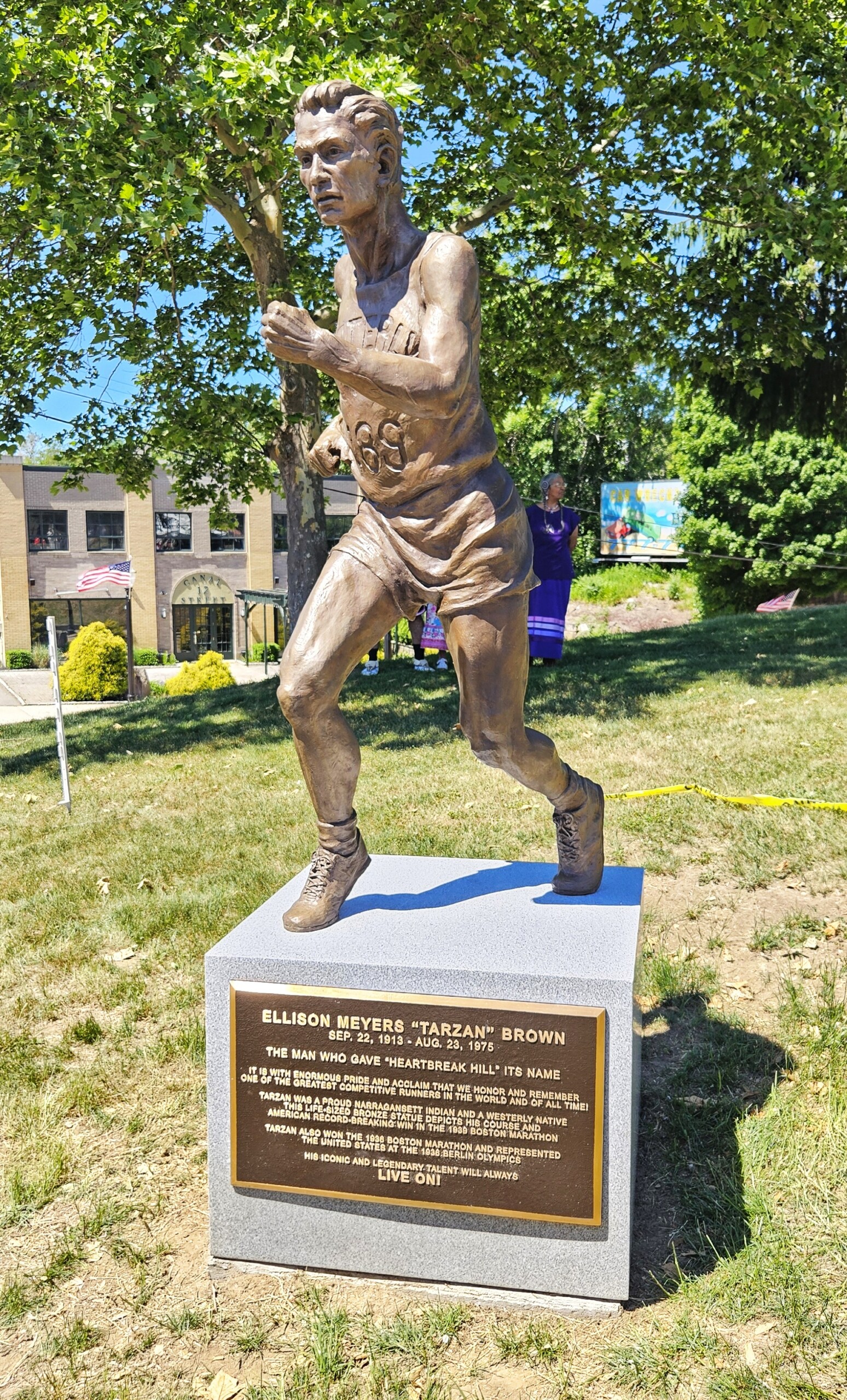
The new statue of Ellison “Tarzan” Brown outside the Westerly train station was designed by local sculptor Serena Bates. (Photos by Lauren Clem)
Dozens gathered in Westerly over the weekend to pay tribute to an icon whose recognition is long overdue.
Ellison “Tarzan” Brown was a Westerly native who won the 1936 and 1939 Boston Marathons. He was also a member of the Narragansett Tribe whose famous feats have gone down in local Indigenous history.
“My Uncle Tarzan is one of those legends who took the tribe and ran not only for himself, but all the people. And put them on his back,” says Thawn Sherenté Harris, Brown’s great-nephew who ran the Boston Marathon this year in his great-uncle’s memory.
Harris was among those who participated in the dedication Saturday of a new statue of Brown at Westerly’s Rooney Park, next to the train station. Harris and his wife, Eleanor Dove Harris, performed an honor song during the proceedings. The statue was crafted by local sculptor Serena Bates. The Ellison “Tarzan” Brown Memorial Fund, a group created by family members and local running enthusiasts, fundraised nearly $70,000 to establish the tribute.
“We all have looked up to Uncle Tarzan and his accomplishments, which is nothing new for the Narragansett people,” Harris says.
Byron Brown — Brown’s nephew, Chief Sachem “Sunrise” of the Wiquapaug Eastern Pequot Indian Tribe and a member of the fund’s steering committee — opened the dedication with a greeting and thanked those in attendance. The event brought together a diverse group of supporters, from Westerly town officials, to members of the Brown family, to running enthusiasts, to representatives of local Indigenous tribes. Brown and others joined in smoking a peace pipe to formally dedicate the statue.
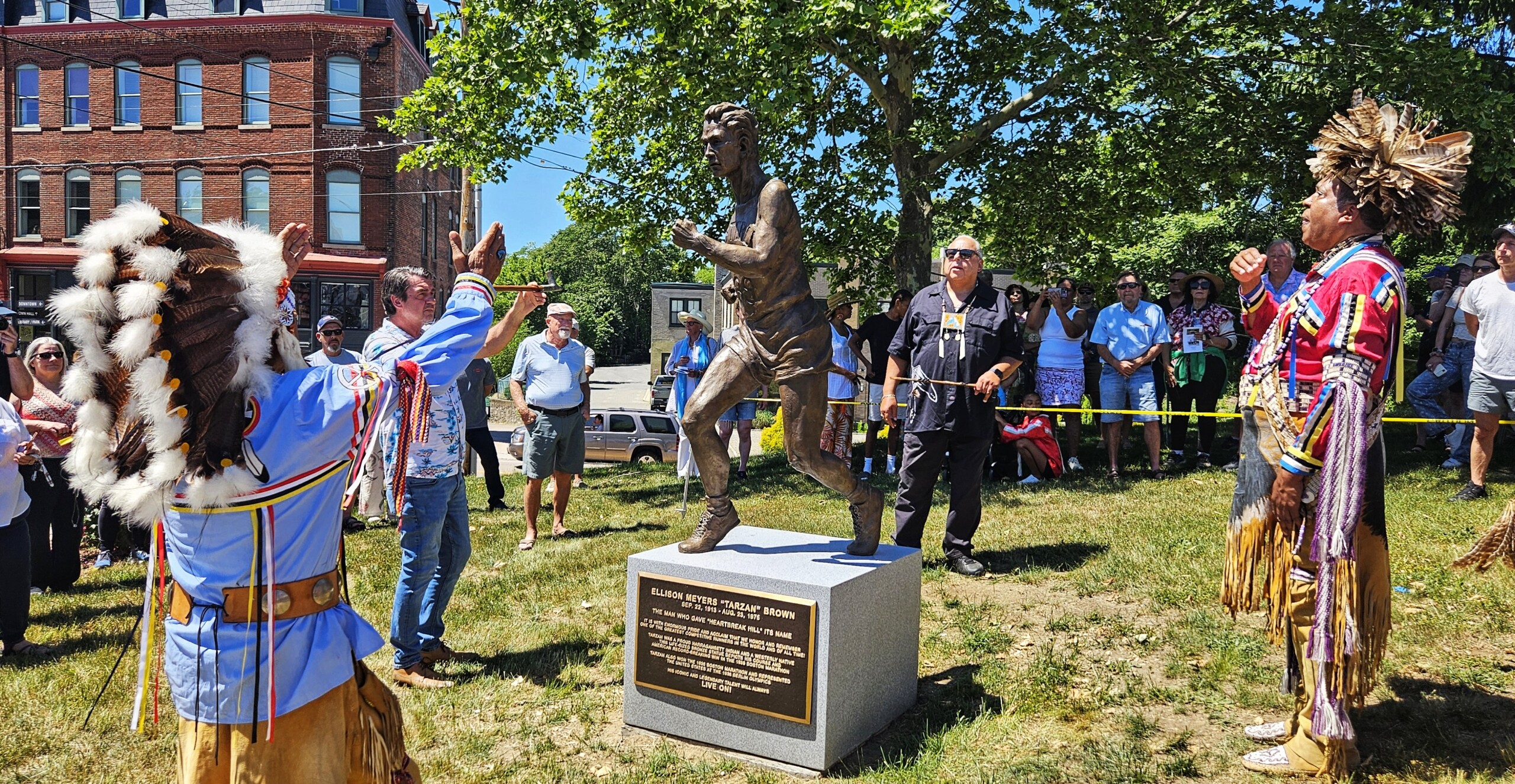
Representatives of local Indigenous tribes smoke a peace pipe to formally dedicate the statue.
Town Manager Shawn Lacey noted the statue’s highly visible location makes it one of the first sights for visitors who disembark at the local Amtrak station. As if to demonstrate his point, an Amtrak train came through during the ceremony, stopping just feet away from where the speaking program was taking place.
“I think it’s wonderful for the tens of thousands of people who will visit the statue over the next 250 years. Keep in mind the hundreds of thousands of Amtrak passengers who come through here,” Lacey says.
The program featured remarks from several running greats, including Geoff Smith, a two-time Olympian who won the Boston Marathon in 1984 and 1985. Smith recounted the difficulty of training for the marathon in its earlier years, as well as the statue of Brown’s competitor, Johnny Kelley, that stands not far from the start of Heartbreak Hill. In 1936, Brown gave Heartbreak Hill its name when he retook the lead from Kelley after Kelley passed him on its slopes. Brown would go on to defeat Kelley and claim the 1936 title, becoming only the second Indigenous runner to win a Boston Marathon.
“Time moves on, and it’s a great thing that we remember the past and the legends who are out there. Tarzan Brown was a true legend,” Smith says.
For family members, the ceremony was an opportunity to remember a man who was as much a presence in their lives as he was the stuff of running legend. Some of those legends were repeated on Saturday, with certain achievements — winning back-to-back marathons on two consecutive days in New Hampshire and New York — more verifiable than others. Brown is also said to have jumped in Lake Cochituate during a particularly hot Boston Marathon and brawled with Nazis in a bar while in Berlin for the 1936 Olympics.
Anna Brown-Jackson, Brown’s granddaughter, said her grandfather would have been proud of the recognition.
“He was already a legend in our hearts and minds because he was grandpa, and he’ll always be grandpa,” she says.
She also recalled her uncle’s trainer, Thomas “Tippy” Salimeno Sr., a Westerly resident and Italian American who helped spur Brown on to success. Salimeno’s son, Thomas Salimeno Jr., now 100 years old, was in attendance at the ceremony.
“Together they broke barriers not only in the state of Rhode Island and Westerly, but in the world,” Brown-Jackson says.
As mentioned during the dedication, the Steering Committee is still raising funds for additional improvements on the site, including a security camera to protect the statue from vandalism. For more information on the statue or to donate, visit tarzanbrownmemorialfund.org.
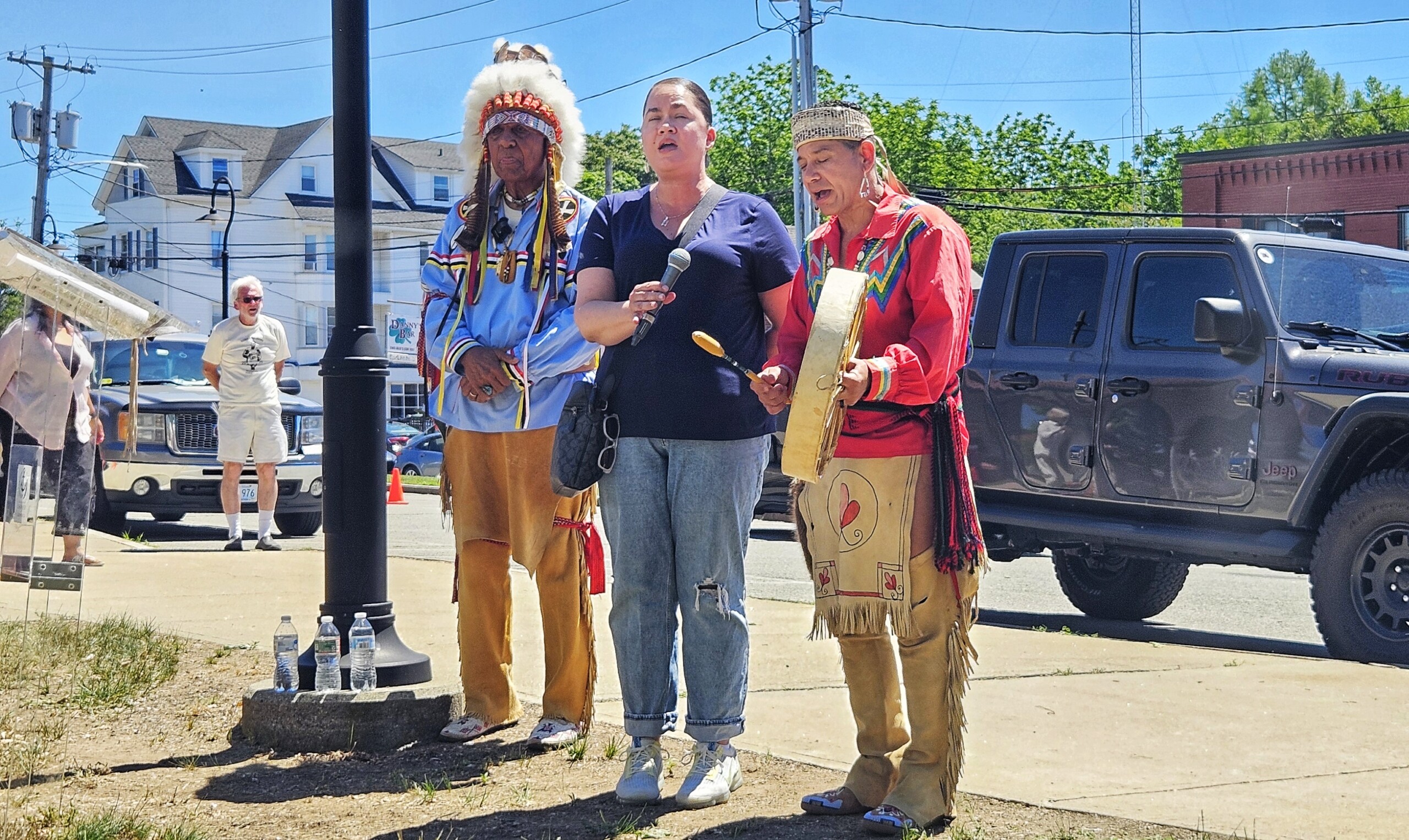
Eleanor Dove Harris and Thawn Sherenté Harris, who ran the Boston Marathon this year in his great-uncle’s memory, perform an honor song during the ceremony. At left is Brown’s nephew, Byron Brown.
RELATED ARTICLES
Local Ways to Celebrate Juneteenth Freedom Day
The Story of Ellison “Tarzan” Brown
New Woonsocket Exhibit Highlights Lao Americans’ Story in Rhode Island